


EU and US equity indices slid yesterday, with the exception being Nasdaq, perhaps due to month-end rebalancing. Overnight, the RBA kept interest rates and its target on government bond yields unchanged at 0.25%, but increased the size of its Term Funding Facility. As for today, the main item on the agenda may be Eurozone’s preliminary CPIs for August.
Equities Slide on Month-end Rebalancing
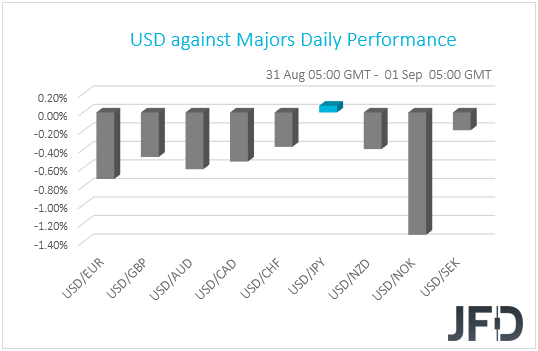
The US dollar traded lower against all but one of the other G10 currencies on Monday and during the Asian morning Tuesday. It was found fractionally higher only against JPY, while it lost the most ground versus NOK, EUR, and AUD in that order.
The weakening of the dollar and the yen suggests that the financial community continued trading in a risk-on fashion. However, turning our gaze to the equity world, we see that this was not the case. Major EU indices were a sea of red, while later, in the US, both the Dow Jones and the S&P 500 slid 0.78% and 0.22% respectively. Only Nasdaq closed its trading higher (0.68%), aided by gains in both Tesla and Apple after their stock splits, as the lower prices may be making those stocks more attractive to retail investors. Risk sentiment improved somewhat during the Asian session today, perhaps after China’s Caixin manufacturing PMI rose to 53.1 from 52.8, instead of sliding to 52.6 as the forecast suggested. Both Japan’s Nikkei 225 and China’s Shanghai Composite traded virtually unchanged, while South Korea’s KOSPI is currently up 0.86%.
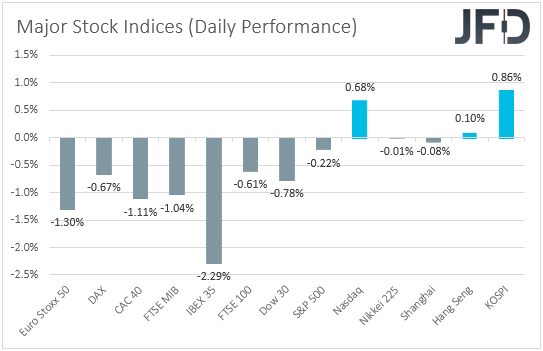
In our view, yesterday’s slide in equities may have been the reason of month-end rebalancing, rather than a trend reversal. With central banks willing to do more in order to support the global economy from the effects of the pandemic, and with headlines surrounding a potential vaccine coming in on the bright side, we would consider the current retreat as a corrective phase. We still see decent chances for a rebound in equities and other risk-linked assets, something that could continue weighing on safe havens, like the US dollar and the Japanese yen.
RBA Increases Size of Term Funding Facility
Overnight, we also had a central bank deciding on monetary policy, and this was the RBA. The Bank decided to maintain the targets for the cash rate and the yield on 3-year Government bonds at 0.25%, but also increased the size of its Term Funding Facility, in order to make it easier for banks to access more funds for longer. Officials reiterated that the downturn due to the coronavirus is not as severe as earlier expected, but underlined that the recovery is likely to be both uneven and bumpy, adding that they remain willing to expand their stimulative efforts if deemed necessary. They also referred to the Aussie, saying that it has appreciated, to be around its highest level in nearly two years. That said, they didn’t appear concerned over its appreciation.
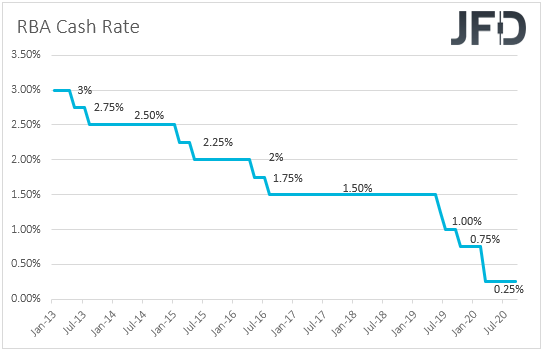
The currency barely reacted at the time of the announcement, confirming our view that it is mostly linked to developments surrounding the broader investor morale, rather than small tweaks to monetary policy. If risk appetite returns into the market, due to its risk-linked property, the Aussie is likely to continue being benefited, especially against currencies which are seen as safe havens, the likes of the US dollar and the Japanese yen.
AUD/USD – Technical Outlook
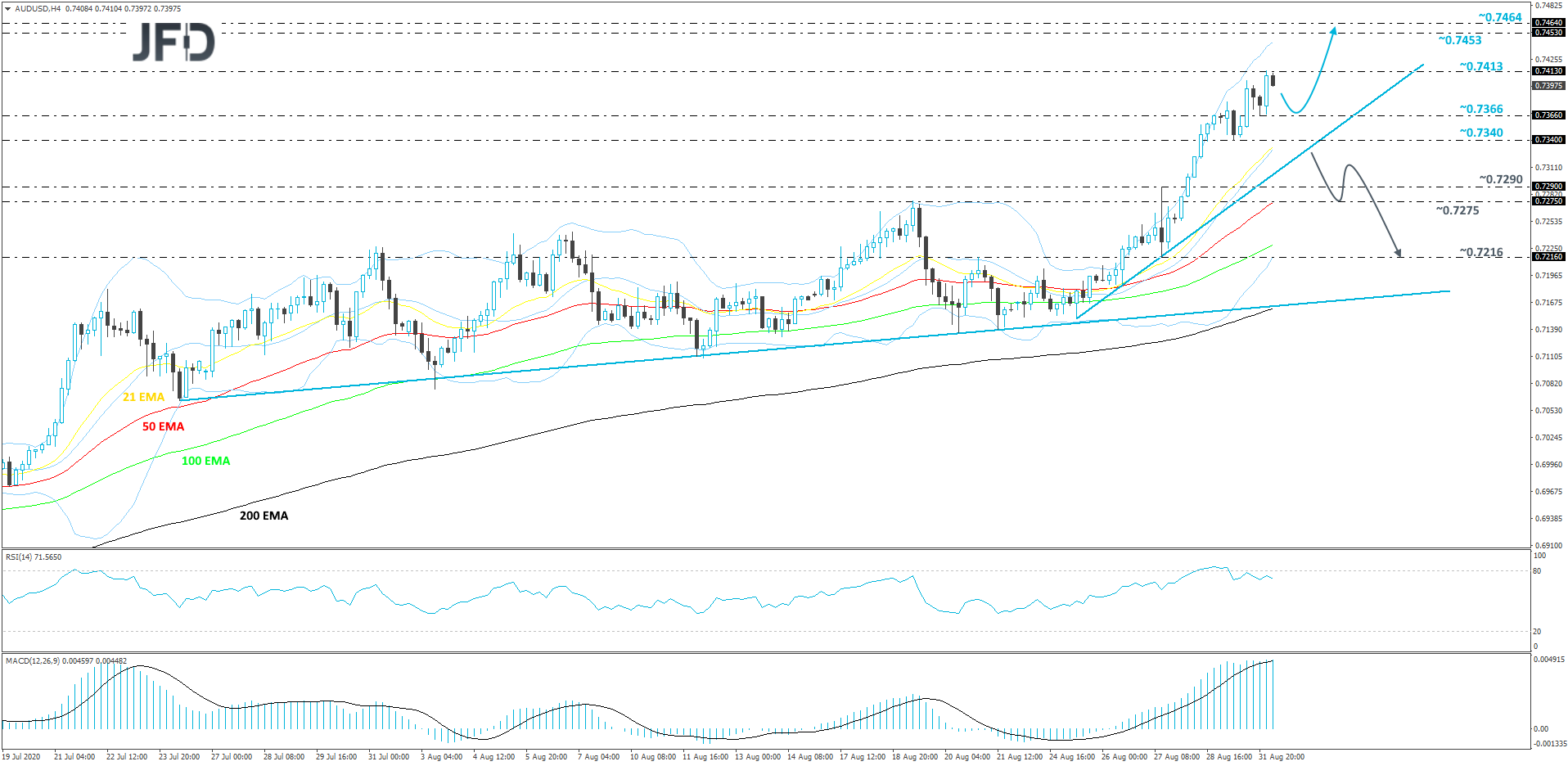
AUD/USD continues with its journey north, by forming higher lows and higher highs. The pair currently had a strong uprise and is now trading above a short-term upside support line drawn from the low of August 25th. The RSI and the MACD are showing signs of topping on our 4-hour chart, which could result in the rate correcting a bit lower. That said, we still don’t see any indication of a possible change in the current trend. As long as the above-mentioned upside line stays intact, we will remain positive, at least with the near-term outlook.
A small decline may bring the rate to the 0.7366 hurdle, marked by yesterday’s intraday swing low, or to the aforementioned upside line, which if remains intact, could be seen as a good support area. A bounce might lead AUD/USD back to the 0.7413 barrier, marked by the current high of today, a break of which could set the stage for further advances, as such a move would confirm a forthcoming higher high. That’s when we will aim for the 0.7453 zone or the 0.7464 level, marked by the highest point of August 2018 and the high of July 25th, 2018, respectively.
On the downside, if the previously-discussed upside line breaks, that could temporarily spook the bulls from the field, allowing more sellers to jump in. If so, AUD/USD could drift towards the next potential support area between the 0.7275 and 0.7290 levels, marked by the highs of August 19th and 27th respectively. The pair might stall there for a bit, but if the bears are still feeling confident, the next possible target could be at 0.7216, marked by the low of August 27th.
Eurozone Inflation Set to Slow
As for today, the main release may be Eurozone’s preliminary CPIs for August. The headline rate is forecast to have declined to +0.2% yoy from +0.4%, while the core one is anticipated to have slid to +0.8% yoy from +1.2%.
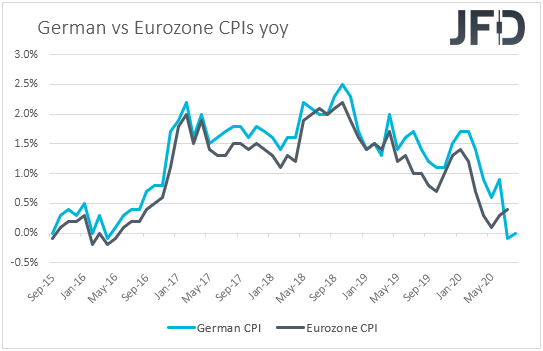
At its last meeting, the ECB did not alter its monetary policy, but stayed ready to adjust all its instruments, as appropriate, to ensure that inflation moves towards its aim in a sustained manner. With that in mind, further slowdown in consumer prices may increase the chances for additional easing by the ECB, and perhaps hurt somewhat the euro. However, we don’t expect this data set to prove the catalyst behind a trend reversal in EUR/USD. With the greenback staying under selling pressure due to the recent risk-on trading, we would treat any pull back in the pair as a corrective phase of the broader medium-term uptrend.
EUR/USD – Technical Outlook
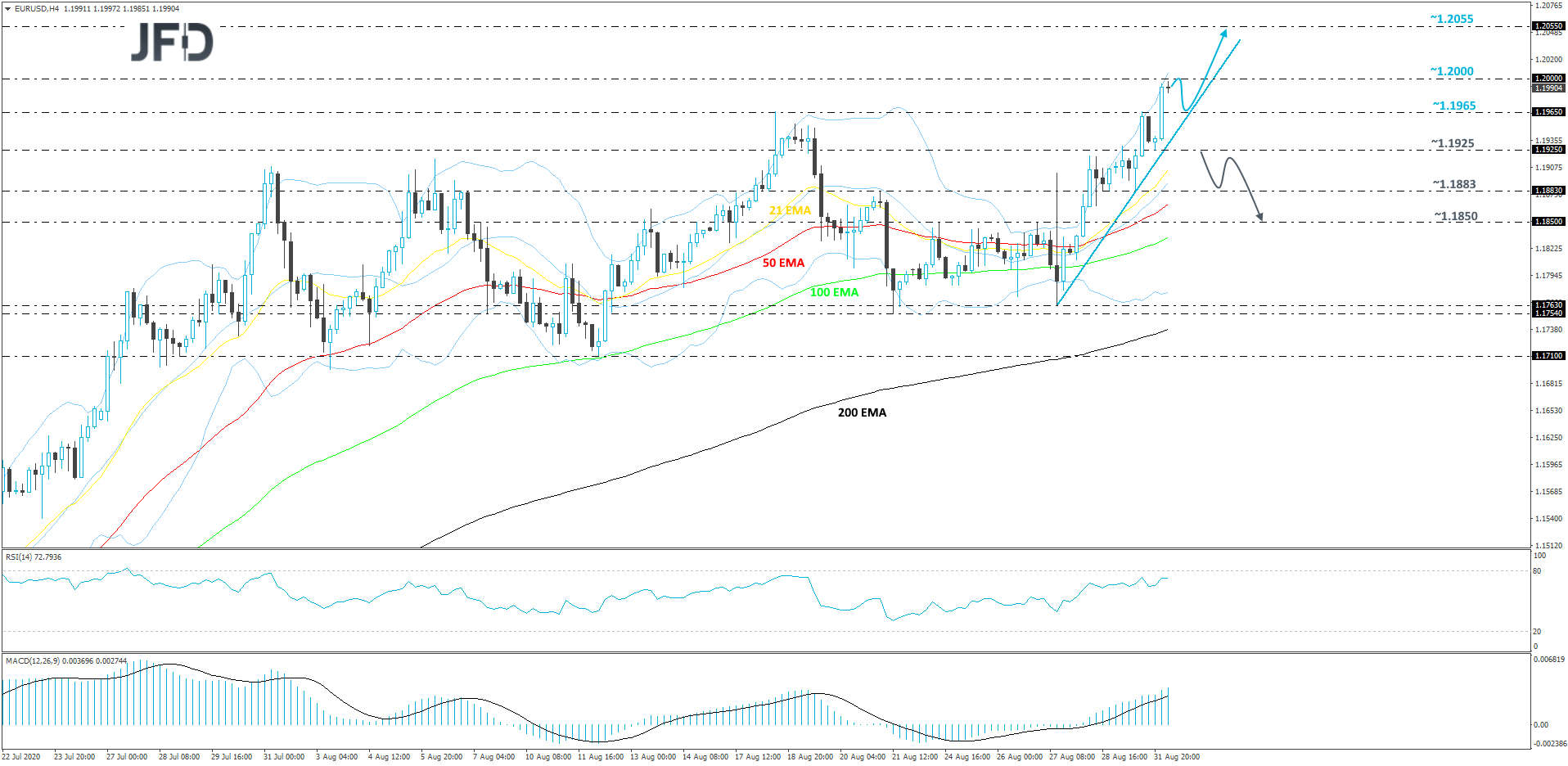
During the past few trading days, EUR/USD has been moving steeply to the upside, while balancing above a short-term tentative upside support line taken from the low of August 27th. This morning, the rate came close to testing the psychological 1.2000 zone but got held fractionally below it. Even if the pair declines slightly, as long as it stays above that steep upside line, the outlook could remain positive, at least for now.
If EUR/USD moves a bit lower, tests the aforementioned upside support line, but fails to move below it, the bulls might take action and lift the rate up again. Such a move could bring the pair back to the area near the psychological 1.2000 hurdle, a break of which would confirm a forthcoming higher high and may clear the path towards higher levels. This is when we will aim for the 1.2055 barrier, marked by the lowest point of April 2018.
Alternatively, if the previously-mentioned upside line breaks and the rate falls below the 1.1925 zone, marked by an intraday swing low of August 31st, that may signal a change in the short-term trend. More bears could be joining in and potentially sending EUR/USD to the 1.1883 hurdle, marked by the low of August 31st, where the pair could get a hold-up. That said, if the bears are still feeling comfortable, a break of that hurdle may open the door for a push to the 1.1850 level, marked near the highs of August 24th and 27th.
As for the Rest of Today’s Events
During the European day, apart from Eurozone’s CPIs, we also get the final manufacturing PMIs for August from several Eurozone nations and the bloc as a whole. As it is always the case, the final prints are expected to confirm their preliminary estimates. The UK final manufacturing PMI is also coming out.
Later in the day, we get the US final Markit manufacturing index, alongside the ISM manufacturing PMI for the month. The final Markit print is expected to match its initial estimate, while the ISM index is expected to have risen fractionally, to 54.5 from 54.2.
With regards to the energy market, the API (American Petroleum Institute) weekly report on crude oil inventories is coming out, but as it is always the case, no forecast is available.
Tonight, during the Asian session Wednesday, we have Australia’s GDP for Q2. The forecast suggests that the Australian economy contracted 6.0% qoq after sliding 0.3% in the first quarter. This is likely to drive the yoy rate down to -5.3% from +1.4%. A -5.3% yoy GDP rate would still be above the RBA’s own forecast for the quarter, which is at -6.0% yoy, and thus, we don’t expect this release to alter expectations around the RBA’s future plans. We believe that a much-worse-than-expected print is needed to spark speculation for additional easing by this Bank.
We also have three speakers on today’s agenda: ECB Vice President Luis de Guindos, ECB Executive Board member Philip Lane, and FOMC Board Governor Lael Brainard.
Disclaimer:
The content we produce does not constitute investment advice or investment recommendation (should not be considered as such) and does not in any way constitute an invitation to acquire any financial instrument or product. The Group of Companies of JFD, its affiliates, agents, directors, officers or employees are not liable for any damages that may be caused by individual comments or statements by JFD analysts and assumes no liability with respect to the completeness and correctness of the content presented. The investor is solely responsible for the risk of his investment decisions. Accordingly, you should seek, if you consider appropriate, relevant independent professional advice on the investment considered. The analyses and comments presented do not include any consideration of your personal investment objectives, financial circumstances or needs. The content has not been prepared in accordance with the legal requirements for financial analyses and must therefore be viewed by the reader as marketing information. JFD prohibits the duplication or publication without explicit approval.
CFDs are complex instruments and come with a high risk of losing money rapidly due to leverage. 84.25% of retail investor accounts lose money when trading CFDs with the Company. You should consider whether you understand how CFDs work and whether you can afford to take the high risk of losing your money. Please read the full Risk Disclosure.
Copyright 2020 JFD Group Ltd.