

Most equity indices pulled back yesterday and today in Asia, while the US dollar gained against all the other G10 currencies, perhaps due to rising US treasury yields. As for today, attention may fall on the minutes from the latest FOMC gathering, with investors perhaps eager to find out whether the dovish view of Fed Chair Powell is shared among other members as well.
Investors Lock Gaze on the FOMC Meeting Minutes
The US dollar traded higher against all the other G10 currencies on Tuesday and during the Asian morning Wednesday. It outperformed the most versus NOK, NZD and CAD in that order, while it gained the least against GBP, JPY and SEK.
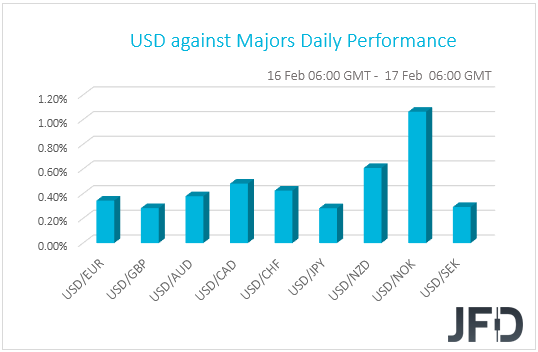
The strengthening of the US dollar and the safe-haven yen, combined with the weakening in the commodity-linked Kiwi and Loonie, suggests that markets traded in a risk-off fashion yesterday and today in Asia. However, as we noted recently, the US dollar may have started losing its safe-haven appeal and thus, in order to get a clearer picture with regards to the broader market sentiment, we prefer to turn our gaze to the equity world. There, most of the major EU indices ended their session in the red, while in the US, both the S&P 500 and Nasdaq slid 0.06% and 0.34% respectively. Only Dow Jones gained 0.20%. The negative investor morale rolled somewhat over into the Asian session today as well. Although Hong Kong’s Hang Seng gained 0.60%, Japan’s Nikkei and South Korea’s KOSPI fell 0.58% and 0.93%. China’s Shanghai Composite stayed closed due to the celebrations of the Lunar New Year.
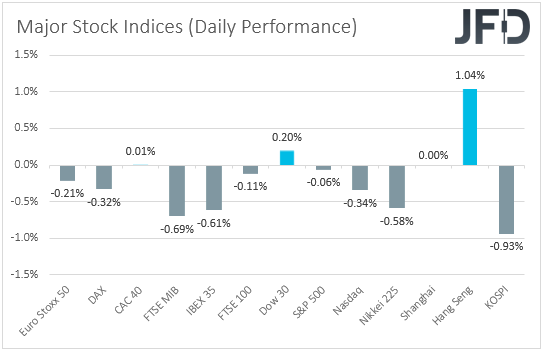
The strengthening of the US dollar and the retreat in equities may have been the result of rising US treasury yields, as investors may have reckoned that a stimulus-fueled global recovery will eventually drive inflation higher. However, with central banks around the world committed to keep their policy extra loose for long, we stick to our guns that equities are likely to continue trending north for a while more. We would treat yesterday’s pullback, or any short-term extensions of it, as a corrective move before the next leg higher. The declining coronavirus infections, the vaccinations, and a large fiscal package in the US, are all developments that may keep investors’ appetite supported as well.
As for today, market participants are likely to lock their gaze on the minutes from the latest FOMC gathering. At that meeting, the Committee decided to keep its monetary policy settings unchanged, with the only material change in the statement being the part saying that “the pace of the recovery in economic activity and employment has moderated in recent months”. While there was some market chatter over QE tapering, at the press conference following the decision, Fed Chair Powell clearly stated that it’s too early to focus on tapering dates.
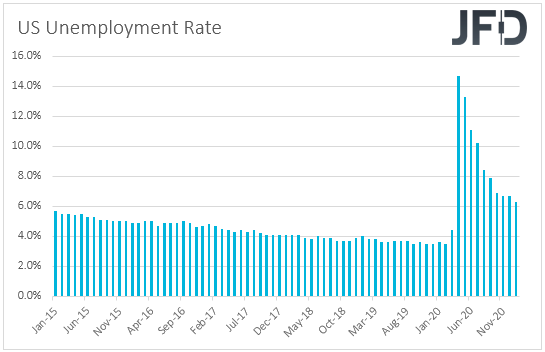
We’ve heard from him last week as well, with the tone of his speech staying on the dovish side. He noted that the improvement in the labor market has stalled in recent months, and even if we do see a strong labor market soon, they will not tighten monetary policy solely in response to that. He affirmed that they will keep interest rates at current levels until the economy has reached maximum employment and inflation stays above 2% for some time. With all that in mind, it will be interesting to search the minutes for clues as to whether other officials are on the same page with their Chief. If so, the US dollar is likely to come under renewed selling interest, while equities and other risk-linked assets may rebound on expectations that the Fed will do whatever it takes to support an economy severely hit by the coronavirus pandemic.
DJIA – Technical Outlook
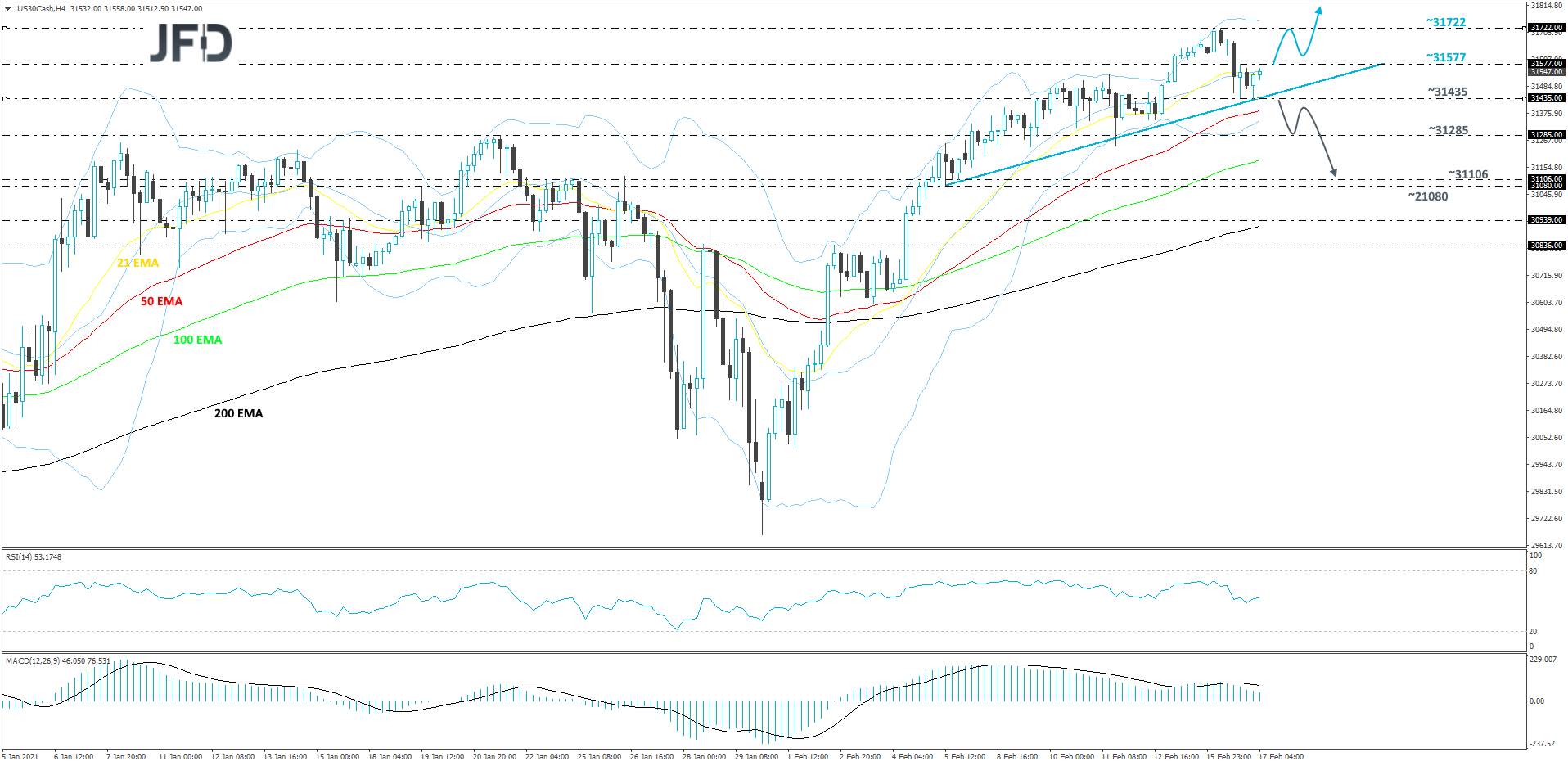
Despite yesterday’s decline, the Dow Jones Industrial Average index continues to float above a short-term tentative upside support line, drawn from the low of February 5th. As long as the price stays above that upside line, the buyers might remain interested in pushing the index higher. But in order to be slightly on the safe side, a break back above the 31577 barrier would be needed. Hence our somewhat-positive approach for now.
If, eventually, the price rises back above the 31577 barrier, marked by yesterday’s intraday swing high, that could attract some new buyers again. The index may get lifted to its all-time high again, at 31722, which could provide a temporary hold-up. That said, if the buyers are still feeling confident then, a break of that barrier will confirm a forthcoming higher high and place the price in the uncharted territory once again.
On the other hand, if the aforementioned upside line breaks and the index falls below the 31435 zone, marked by yesterday’s low, this will confirm a forthcoming lower low, possibly inviting more bears into the field. DJIA could then fall to the 31285 obstacle, a break of which might set the stage for a move to the 31106 hurdle, or the 31080 area, marked by an intraday swing low of February 5th.
USD/CAD – Technical Outlook
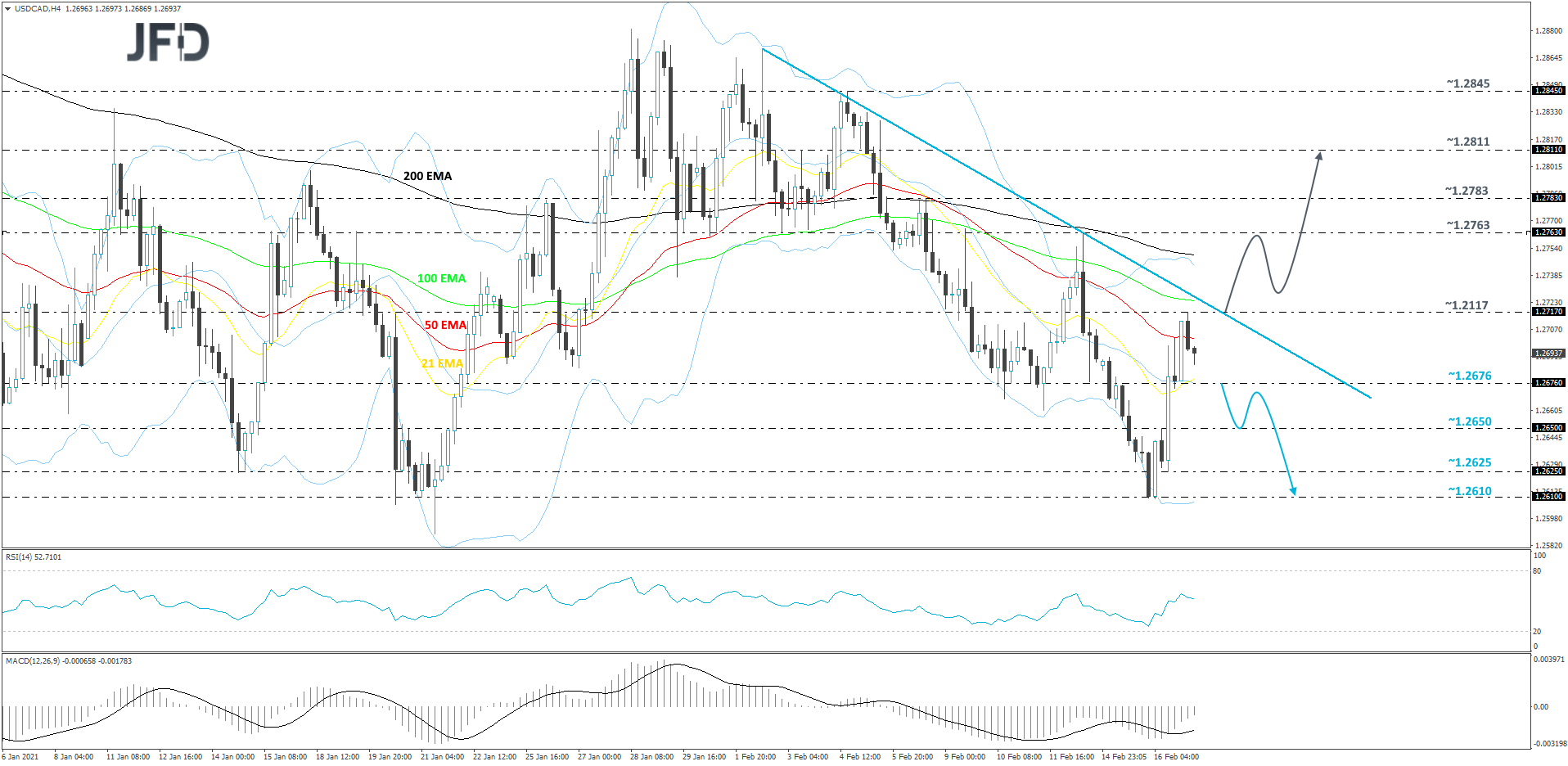
Yesterday, we saw USD/CAD reversing sharply to the upside, but failing to reach a short-term downside resistance line, drawn from the high of February 2nd. Although the upside momentum has picked up again, the pair continues to trade below that downside line and as long as it stays intact, there is a chance to see another slide. However, to support the downside scenario, a drop back below the 1.2676 hurdle, would be needed.
A move below the 1.2676 hurdle, marked by intraday swing lows of February 10th, 11th, 12th and 16th, could open the way to lower areas again. The rate might drop to the 1.2650 zone, marked by an intraday swing high of February 16th, which may temporarily halt the slide. That said, if the bears are still feeling comfortable, USD/CAD could continue with its journey south, possibly targeting the 1.2625 obstacle, or the 1.2610 level, marked by yesterday’s low.
Alternatively, if the aforementioned downside line breaks and the rate rises above the 1.2717 barrier, marked by the current high of today, that may attract more buyers into the game, as such a move might increase the pair’s chances of drifting higher. USD/CAD could then rise to the high of February 12th, at 1.2763, a break of which might set the stage for a push to the 1.2783 obstacle, or to the 1.2811 level, marked by the inside swing high of February 3rd.
As for the Rest of Today’s Events
During the early European morning, we already got the UK CPIs for January, with both the headline and core CPI rates coming in better than anticipated.
Later in the day, we get inflation data from Canada as well. The headline rate is expected to have ticked up to +0.8% yoy from +0.7%, while no forecast is available for the core rate. At its prior meeting, the BoC decided to keep interest rates and the pace of its QE purchases unchanged, disappointing those expecting a small cut or even a re-increase in QE. Officials also noted that “As the Governing Council gains confidence in the strength of the recovery, the pace of net purchases of Government of Canada bonds will be adjusted as required", which suggests that the next policy step for BoC may be tapering QE.
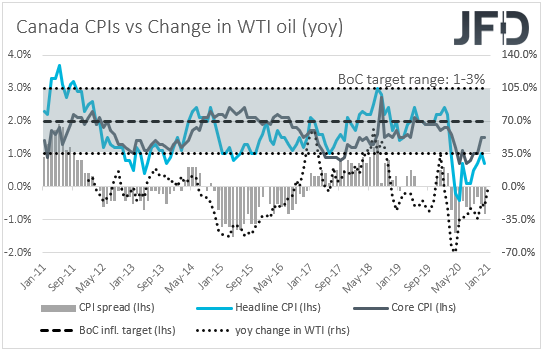
However, the employment report for January disappointed, with the unemployment rate rising to 9.4% from 8.9%, and the net change in employment showing that the economy has lost 212.8k jobs. With that in mind, although a bit higher, an inflation rate well below the BoC’s inflation aim of 2% is unlikely to suggest that tapering may be on the cards in the months to come. A disappointment could even push back expectations on that front, something that may prove negative for the Canadian dollar. That said, with oil prices climbing higher, and the overall market sentiment staying supported, we believe that such a reaction will prove to be temporary. Eventually the commodity-linked currency may recover its inflation-related losses and continue to trend north, at least against the safe havens.
In the US, we have the retail sales and industrial production data for January. Both headline and core sales are expected to have rebounded 1.0% mom, after falling 0.7% and 1.4% respectively, while industrial production is forecast to have slowed to +0.4% mom from +1.6%. The API (American Petroleum Institute) report on crude oil inventories for last week is also coming out but, as it is always the case, no forecast is available.
Tonight, during the Asian morning Thursday, we get Australia’s employment report for January. The unemployment rate is forecast to have slid to 6.5% from 6.6%, while the net change in employment is expected to show that the economy has added another 40.0k jobs, a slowdown from the 50.0k in December.
We also have one speaker on today’s agenda, and this is Richmond Fed President Thomas Barkin.
Disclaimer:
The content we produce does not constitute investment advice or investment recommendation (should not be considered as such) and does not in any way constitute an invitation to acquire any financial instrument or product. The Group of Companies of JFD, its affiliates, agents, directors, officers or employees are not liable for any damages that may be caused by individual comments or statements by JFD analysts and assumes no liability with respect to the completeness and correctness of the content presented. The investor is solely responsible for the risk of his investment decisions. Accordingly, you should seek, if you consider appropriate, relevant independent professional advice on the investment considered. The analyses and comments presented do not include any consideration of your personal investment objectives, financial circumstances or needs. The content has not been prepared in accordance with the legal requirements for financial analyses and must therefore be viewed by the reader as marketing information. JFD prohibits the duplication or publication without explicit approval.
CFDs are complex instruments and come with a high risk of losing money rapidly due to leverage. 79.07% of retail investor accounts lose money when trading CFDs with the Company. You should consider whether you understand how CFDs work and whether you can afford to take the high risk of losing your money. Please read the full Risk Disclosure.
Copyright 2021 JFD Group Ltd.