


Equities pulled back yesterday as Russian forces bombarded the outskirts of Kyiv and a city in northern Ukraine, just after promising to scale down operations. Another reason for the selling may have been end-of-month portfolio rebalancing. Now, market participants may start turning their gaze to the Euro-area CPIs and the US jobs data, both due out tomorrow.
Stocks Slide as Russia Continues to Bomb Ukraine
The US dollar traded mixed against the other major currencies on Wednesday and during the Asian session Thursday. It gained against AUD, JPY, CAD, and NZD in that order, while it lost ground versus EUR, CHF, and GBP.
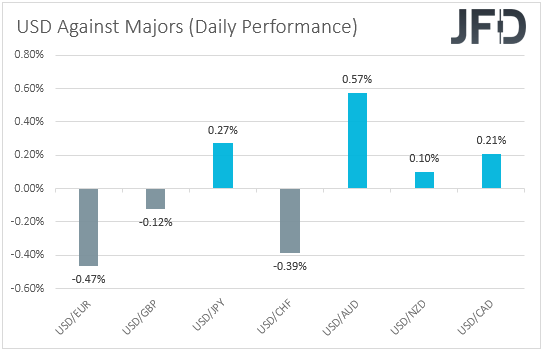
The strengthening of the euro and the weakening of the Japanese yen suggest that markets may have continued trading in a risk-on manner yesterday and today in Asia. However, the strengthening of the Swiss franc and the weakening of the risk-linked Aussie point otherwise. Therefore, with the FX market painting a blurry picture with regards to the broader market sentiment, we prefer to turn our gaze to the equity world. There, we see that major EU and US indices traded in negative waters, with the reduced risk appetite rolling into the Asian session today. Among the indices under our radar, only UK’s FTSE 100 and South Korea’s KOSPI traded in the green.
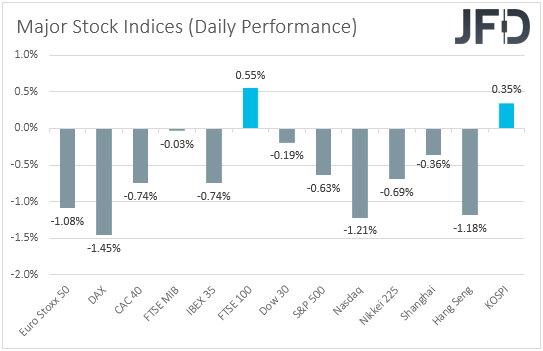
Remember that on Tuesday, equity markets climbed higher due to Russia and Ukraine announcing progress in peace talks held in Turkey. In what it was described as the most tangible sign of progress until now, Russia promised to scale down military operations around Kyiv and norther Ukraine, while Ukraine expressed willingness to adopt a neutral status. That said, yesterday headlines said that Russian forces bombarded the outskirts of Kyiv and a city in northern Ukraine. This may have come as a surprise, with market participants getting disappointed, and scaling back their hope bets over a potential resolution soon. Another reason for the setback in equities may have been that a lot of fund managers may have been rebalancing their portfolios due to the end of the month.
As for our view, we prefer to wait for the turn of the month to see how much of a disappointment Russia’s actions were, and how much of just a rebalancing yesterday’s selling was. For now, market participants may turn their attention away from the war, and lock their gaze on tomorrow’s preliminary Euro-area inflation data, as well as the US jobs report. Accelerating inflation in the Eurozone may add to speculation that the ECB may need to start rising rates sooner than previously anticipated, while a strong employment report in the US, especially accompanied by accelerating wages, could add to chances of a 50bps hike at the Fed’s upcoming gathering, and a steeper rate path thereafter.
DJIA – Technical Outlook
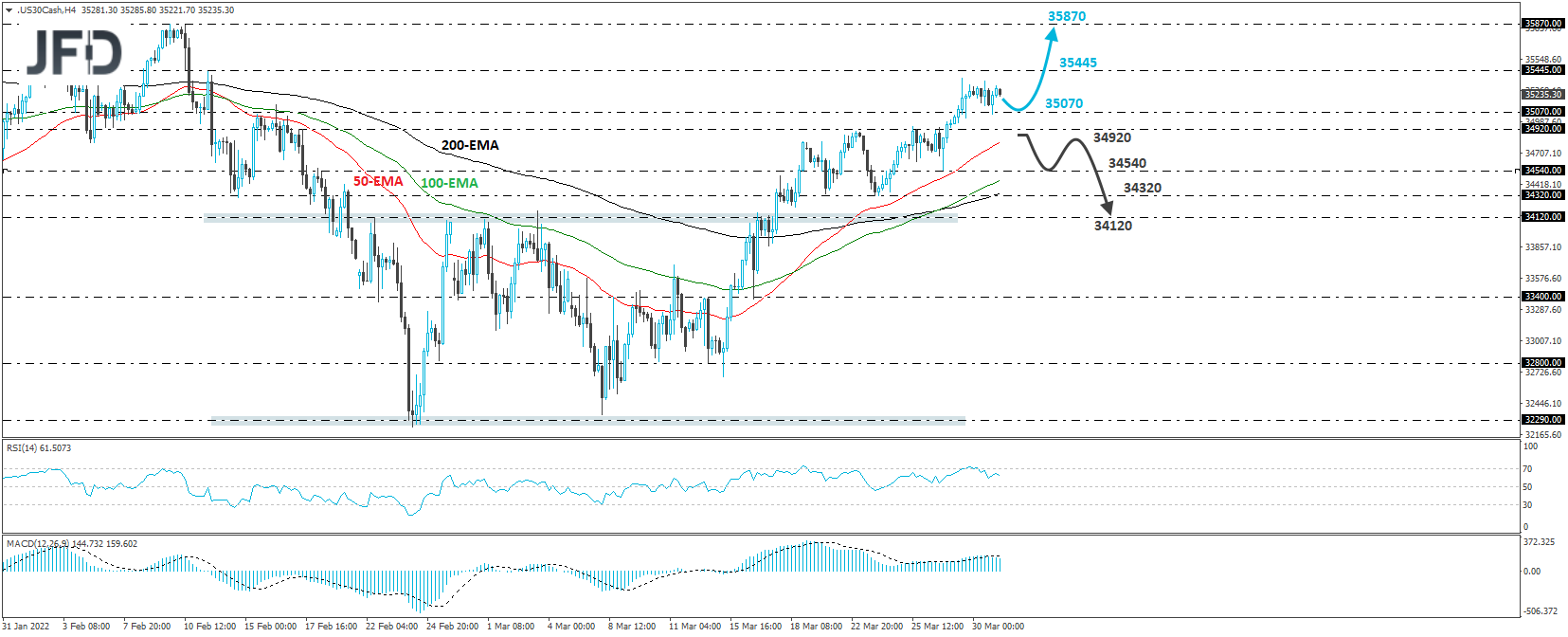
The Dow Jones Industrial Average cash index traded slightly lower yesterday, but rebounded somewhat today in Asia, staying between the 35070 and 35445 barriers. However, the bigger picture still points to a short-term uptrend and thus, we would still see decent chances for another rebound.
Even if the index pulls back once more, we could see the bulls recharging from near the 35070 barrier, and pushing for a test near the high of February 11th, at 35445. If they manage to overcome that hurdle, then we may see the climbing towards the 35870 zone, marked by the highs of February 9th and 10th.
On the downside, we would like to see a clear break below 34920 before we start examining the case of a deeper correction. This could initially pave the way towards the low of March 28th, at 34540, the break of which could aim for the 34320 zone, marked by the lows of March 23rd and 24th, or for the 34120 area, which acted as a strong resistance between February 22nd and March 3rd.
NZD/JPY – Technical Outlook
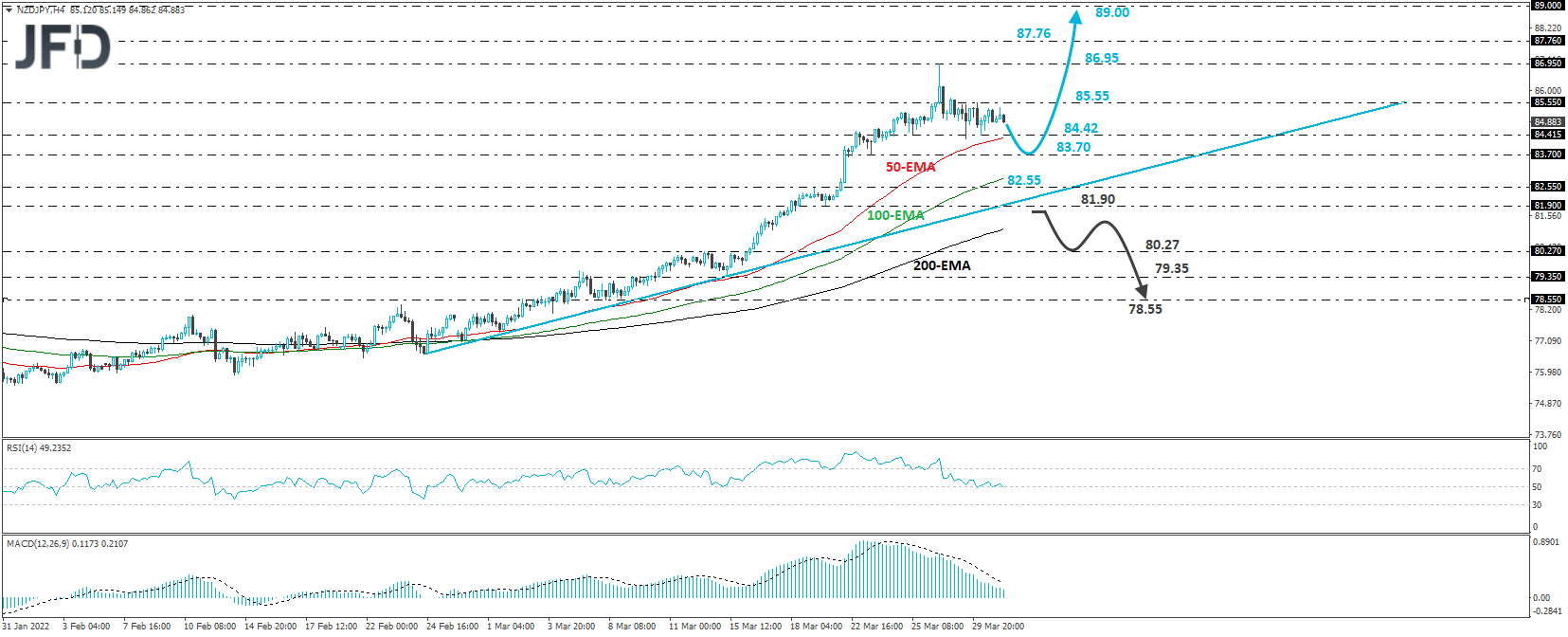
NZD/JPY also stayed range-bound yesterday, between the 84.42 and 85.55 levels. However, overall, it continues to trade above the upside support line drawn from the low of February 24th, and thus, we would consider the near-term outlook to still be positive, even I few see some further retreat.
If a potential setback stays limited above the aforementioned upside line, we would expect the bulls to push for another test near the 85.55 barrier, the break of which could pave the way towards the high of March 28th, at 86.95. Slightly higher lies the 87.76 barrier, marked by the inside swing low of May 12th, 2015, where another break could see scope for extensions towards the 89.00 territory, marked by the high of June 10th, 2015.
We will start examining the case of a potential reversal upon a dip below 81.90, marked by the low of March 21st. This may confirm the break below the aforementioned upside line and may encourage the bears to dive towards the 80.27 zone, marked by the inside swing high of March 14th. If they are not willing to stop there, then we could see them pushing towards the 79.35 level, marked by the low of March 15th, or towards the 78.55 barrier, marked by the low of March 8th.
As for Today’s Events
During the Asian session, we already got the Chinese PMIs for March, with both the manufacturing and services indices sliding to contractionary territory for the first time since the peak of the nation’s COVID outbreak in 2020. This may have been another reason investors abandoned stocks during the Asian trading today.
A few hours ago, the UK final GDP for Q4 was out, with the final print being revised up to +1.3% qoq from +1.0%. Later, we get Germany’s and Eurozone’s unemployment rates for March and February respectively. The German one is expected to have held steady at 5.0%, while Eurozone’s is forecast to have ticked down to 6.7% from 6.8%.
From the US, we have the personal income and spending data for February, as well as the core PCE index for the month, the Fed’s favorite inflation metric. Personal income is expected to have risen 0.5% mom after stagnating in January, while spending is forecast to have slowed to +0.5% mom from +2.1%. No forecast is available for the core PCE index, but bearing in mind that the core CPI rose to +6.4% yoy from +6.0%, we would consider the risks as tilted to the upside. However, at this point, we need to point out that, although it is the Fed’s preferred inflation gauge, the core PCE index is not a major market mover, and this is because we get the CPIs well in advance.
Disclaimer:
The content we produce does not constitute investment advice or investment recommendation (should not be considered as such) and does not in any way constitute an invitation to acquire any financial instrument or product. The Group of Companies of JFD, its affiliates, agents, directors, officers or employees are not liable for any damages that may be caused by individual comments or statements by JFD analysts and assumes no liability with respect to the completeness and correctness of the content presented. The investor is solely responsible for the risk of his investment decisions. Accordingly, you should seek, if you consider appropriate, relevant independent professional advice on the investment considered. The analyses and comments presented do not include any consideration of your personal investment objectives, financial circumstances or needs. The content has not been prepared in accordance with the legal requirements for financial analyses and must therefore be viewed by the reader as marketing information. JFD prohibits the duplication or publication without explicit approval.
CFDs are complex instruments and come with a high risk of losing money rapidly due to leverage. 73.82% of retail investor accounts lose money when trading CFDs with the Company. You should consider whether you understand how CFDs work and whether you can afford to take the high risk of losing your money. Please read the full Risk Disclosure.
Copyright 2022 JFD Group Ltd.