


EU and US indices continued to trend north yesterday, perhaps after preliminary data showed that the Eurozone economy contracted by less than expected in Q4 2020, and due to optimism over the progress of approving a fiscal spending package in the US. In the FX world, the Kiwi was the main G10 gainer, after New Zealand’s much-better-than-expected employment report diminished the chances for the adoption of negative interest rates by the RBNZ.
Stocks Continue Marching North on US Stimulus Optimism
The US dollar traded mixed against the other G10 currencies on Tuesday and during the Asian session Wednesday. It gained against NOK, EUR, AUD, GBP and CHF in that order, while it underperformed versus NZD, CAD and SEK. The greenback was found virtually unchanged against JPY.
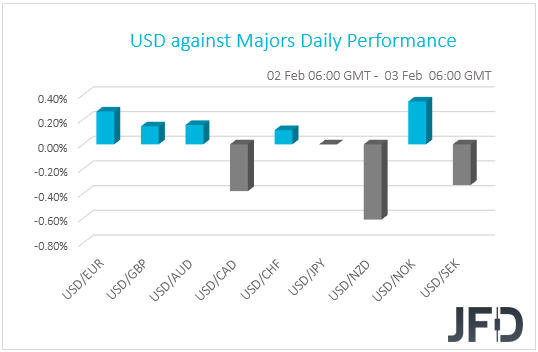
The strengthening of the Kiwi and the Loonie, combined with the weakening of the Swiss franc, suggests that markets traded in a risk-on fashion yesterday and today in Asia. However, the weakening of the Aussie points otherwise. Thus, in order to get a clearer picture with regards to the broader market sentiment, we prefer to turn our gaze to the equity world. There, major EU and US indices were a sea of green, with the optimism easing somewhat during the Asian session today. Although Japan’s Nikkei 225 and South Korea’s KOSPI gained 1.00% and 1.06% respectively, China’s Shanghai Composite and Hong Kong’s Hang Seng slid 0.46% and 0.50%.
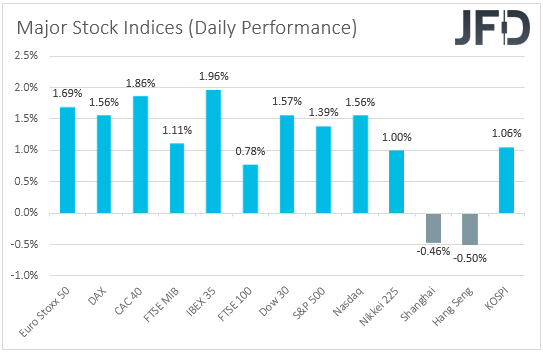
EU indices may have added to Monday gains perhaps after preliminary data showed that the Eurozone economy contracted by less than expected in Q4 2020, as large economies Germany and Spain still managed to expand slightly. UK’s FTSE 100 gained the least among the EU indices, perhaps weighed by reports that the UK variant of the coronavirus has developed a new mutation that could reduce the efficacy of the vaccines. In the US, Wall Street was helped by Amazon and Alphabet, which gained ahead of their earnings results. Market participants were also optimistic over the progress of approving a fiscal spending package in the US, as Congress Democrats took steps in passing Biden’s USD 1.9trln bill without Republican support.
All the above add more credence to our view that the vaccinations, the monetary policy support around the globe, and a large fiscal package in the US, are a blend of developments that are likely to keep the broader market sentiment supported. With all that in mind, we stick to our guns that equities are likely to continue drifting north, while safe havens may stay under selling interest. In the currency world, we expect the pairs consisting of a risk-linked currency and a safe haven to perform well. Such pairs are AUD/USD, NZD/USD, AUD/JPY and NZD/JPY.
Euro Stoxx 50 – Technical Outlook
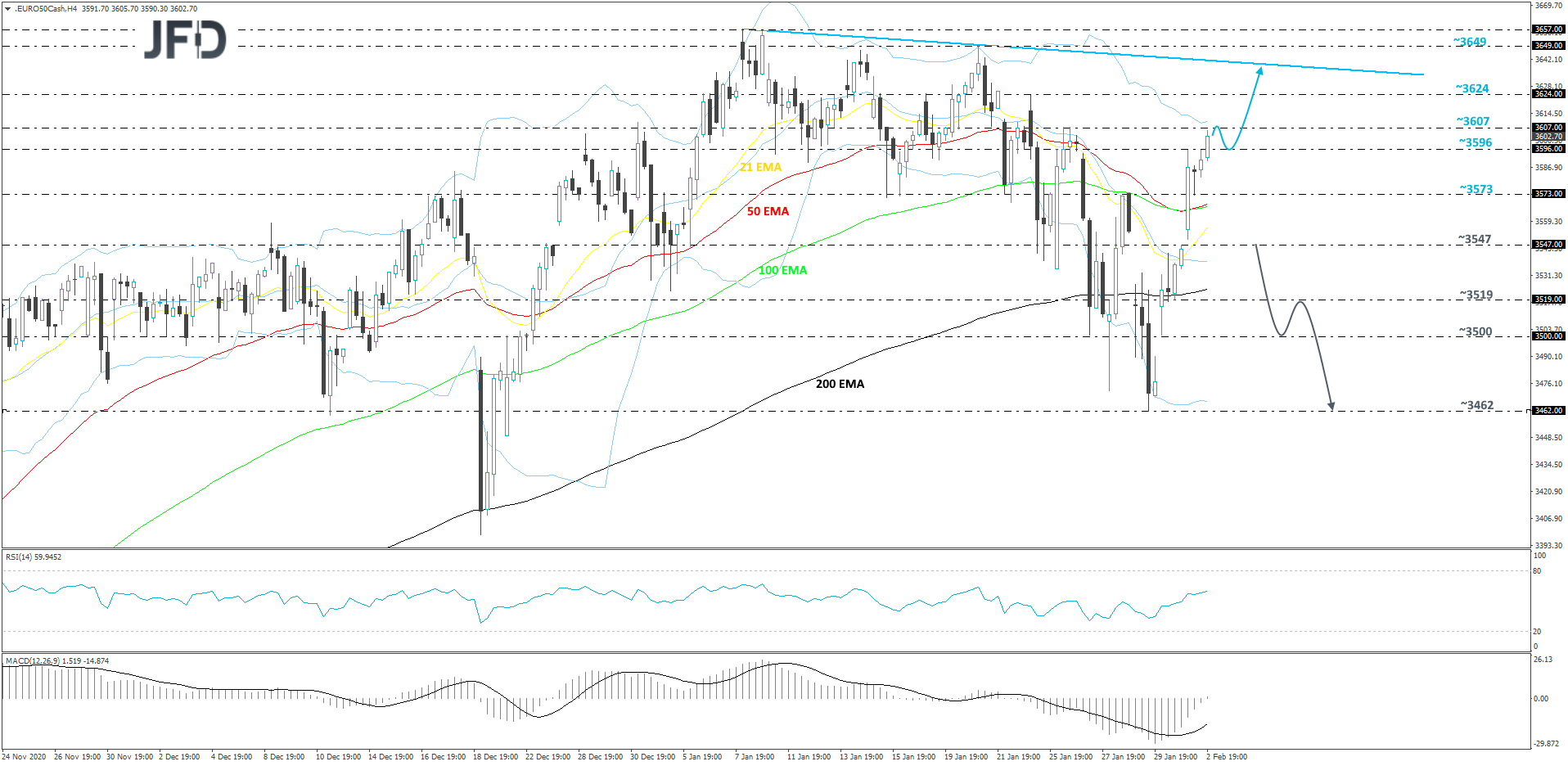
After a sharp reversal to the upside in the beginning of this week, the Euro Stoxx 50 index almost managed to recover all the losses made during last week. By the looks of it, the bulls are not willing yet to leave the driver’s seat, as they continue to drive the price further to the upside. Although we already saw a decent upmove in a short period of time, we will continue aiming for slightly higher areas, at least for now.
The price is currently very close to one of its key resistance barriers, at 3607, which is also marked near the high of January 26th. The Euros Stoxx 50 index might stall there for a bit, however, if the bulls continue to dictate the rules, they may lift the index up again, possibly overcoming the 3607 hurdle and targeting the next one, at 3624, marked by the high of January 25th. A further push north might bring the price to the short-term tentative downside resistance line taken from the high of January 8th, which could provide initial resistance.
In order to shift our attention to lower areas, we would at least wait for a drop below the 3547 hurdle, marked by the high of February 1st. This way, the bulls might get spooked from the field temporarily, this way opening the door for further declines. Euro Stoxx 50 may drop to the 3519 obstacle, or to the psychological 3500 territory, marked by the current low of this week, where the index could stall for a bit. If the sellers are still active, the next potential support target might be at 3462, which is the lowest point of January.
Kiwi Rallies on Better Employment Data
Speaking about currencies, the Kiwi was the main G10 gainer, coming under strong buying interest overnight, after New Zealand’s employment data for Q4 beat market consensus. The unemployment rate declined to 4.9% from 5.3%, instead of rising to 5.6% as the forecast suggested, while the employment change showed that the economy added 0.6% qoq jobs, after losing 0.8% in Q3. The forecast was for another 0.8% qoq loss.
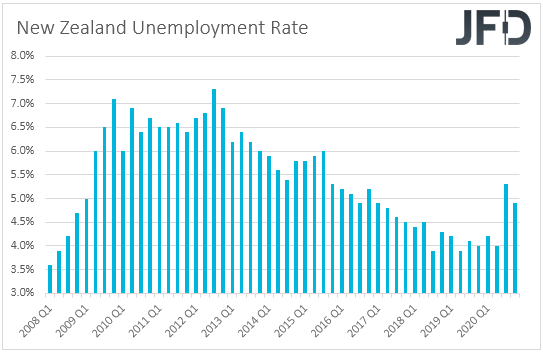
Back in November, the RBNZ decided to keep its official cash rate and its Large-Scale Asset Purchase program unchanged, with Governor Adrian Orr saying that domestic activity since August has been more resilient than previously assumed. With that in mind, and taking into account that inflation stayed unchanged at +1.4% yoy in Q4, within the Bank’s target range of 1-3%, we believe that the better-than-expected employment report may have diminished the chances for the adoption of negative interest rates by this central bank. This, combined with an improved overall market sentiment, are likely to keep the New Zealand dollar supported. Bearing in mind that the RBA decided to expand its QE purchases yesterday, we see the case for the Kiwi to outperform even its Australian counterpart. In other words, we believe that AUD/NZD is likely to continue drifting south.
NZD/USD – Technical Outlook
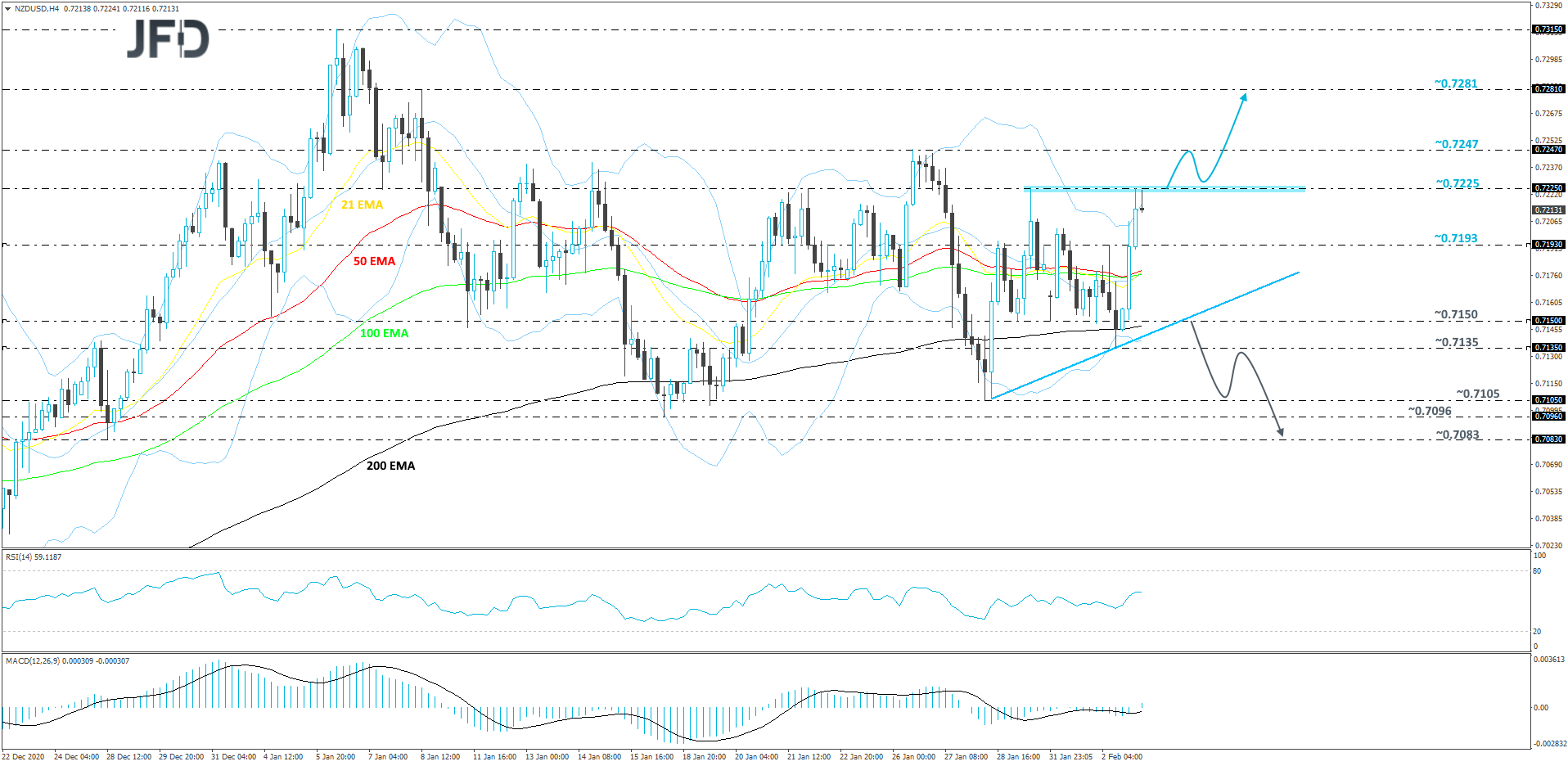
NZD/USD popped higher yesterday, this way getting back into positive territory for the week. However, the pair is currently finding resistance near the 0.7225 barrier, marked by the high of January 29th. In order to get comfortable with the idea of seeing further advances, we would like to see a break of that barrier first. Until then, we will take a cautiously-bullish stance.
If, eventually, the pair makes a move higher and breaks the previously-mentioned 0.7225 zone, this could clear the path for a possible rise to the highest point of last week, at 0.7247, where the rate might stall for a bit. That said, if the buyers are still feeling comfortable, they may easily raise NZD/USD above that 0.7247 hurdle and aim for the next possible resistance area, at 0.7281.
On the downside, a drop below a short-term tentative upside support line, drawn from the low of January 28th, and a push below the 0.7150 zone, marked near the lows of January 29th, 31st and an intraday swing low of February 2nd, could strengthen the bearish case. NZD/USD might then drift to the 0.7135 obstacle, or even to the 0.7105 area, marked by the low of January 28th. The pair may get a temporary hold-up around there, however, if the bears are still coming out on top, the next possible target to consider might be at 0.7096, or at 0.7083, marked by the lowest point of January and the low of December 28th.
As for Today’s Events
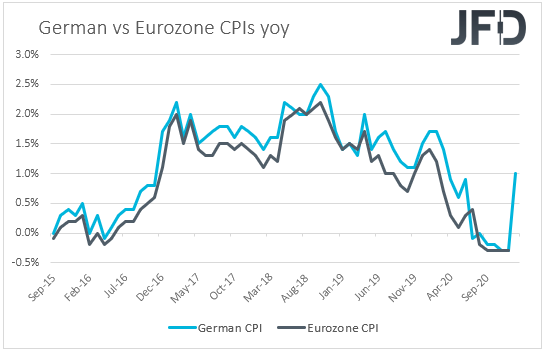
During the European trading, we have Eurozone’s preliminary CPIs for January. The headline CPI rate is forecast to have rebounded to +0.5% yoy from -0.3%, while the HICP excluding energy and food is forecast to have accelerated to +0.7% yoy from +0.4%. Despite the lockdown measures around the Eurozone, at the latest ECB gathering, President Lagarde said that the downside risks to the economic outlook are now “less pronounced”, making investors skeptical over further easing by the ECB, although the Bank repeated once again that it stands ready to adjust all of its instruments as appropriate. Thus, improving inflation rates may reduce even further speculation over more easing by the ECB, at least at its upcoming gathering.
We also get the final Markit services and composite PMIs for January from the Eurozone, the UK and the US, with the final prints expected to confirm their preliminary estimates. In the US, we also get the ISM non-manufacturing PMI for January, which is expected to have fallen to 55.0 from 60.5, as well as the ADP employment report, which is forecast to show that the private sector has gained 45k jobs after losing 123k in December.
As for the speakers, we have two on the agenda and those are St. Louis Fed President James Bullard and Philadelphia Fed President Patrick Harker.
Disclaimer:
The content we produce does not constitute investment advice or investment recommendation (should not be considered as such) and does not in any way constitute an invitation to acquire any financial instrument or product. The Group of Companies of JFD, its affiliates, agents, directors, officers or employees are not liable for any damages that may be caused by individual comments or statements by JFD analysts and assumes no liability with respect to the completeness and correctness of the content presented. The investor is solely responsible for the risk of his investment decisions. Accordingly, you should seek, if you consider appropriate, relevant independent professional advice on the investment considered. The analyses and comments presented do not include any consideration of your personal investment objectives, financial circumstances or needs. The content has not been prepared in accordance with the legal requirements for financial analyses and must therefore be viewed by the reader as marketing information. JFD prohibits the duplication or publication without explicit approval.
CFDs are complex instruments and come with a high risk of losing money rapidly due to leverage. 79.07% of retail investor accounts lose money when trading CFDs with the Company. You should consider whether you understand how CFDs work and whether you can afford to take the high risk of losing your money. Please read the full Risk Disclosure.
Copyright 2021 JFD Group Ltd.