


The US dollar traded lower against most of the other major currencies yesterday and today in Asia, while equities continued drifting north, with the S&P 500 hitting a fresh record high. It seems that last week’s reports confirming that the Omicron coronavirus variant is not as deadly as prior strains, kept market participants willing to increase their exposure this week as well.
Risk Appetite Stays Strong as Omicron Concerns Continue to Ease
The US dollar traded lower against all but two of the other major currencies on Monday and during the Asian session Tuesday. It gained only against JPY, while it was found virtually unchanged versus NZD. The greenback lost the most versus GBP and CHF.
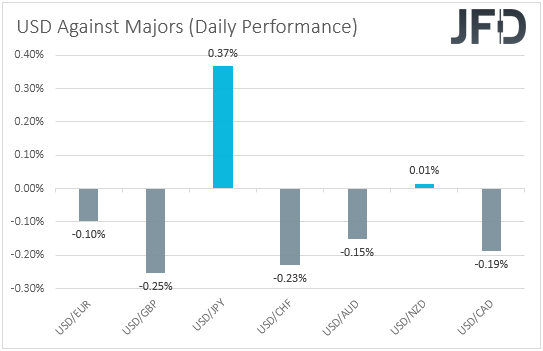
Now, the weakening of the Japanese yen and the US dollar suggests that markets continued trading in a risk-on fashion yesterday and today in Asia. However, the strengthening of the Swiss franc points otherwise. Therefore, in order to get a clearer picture with regards to the broader investor morale, we prefer to turn our gaze to the equity world. There, we see that indeed, major European indices kept marching north, with the optimism rolling and strengthening during the US session. It is worth mentioning that the S&P 500 surged to hit a new record. Stock indices remained supported during the Asian session today as well, with Japan’s Nikkei gaining the most.
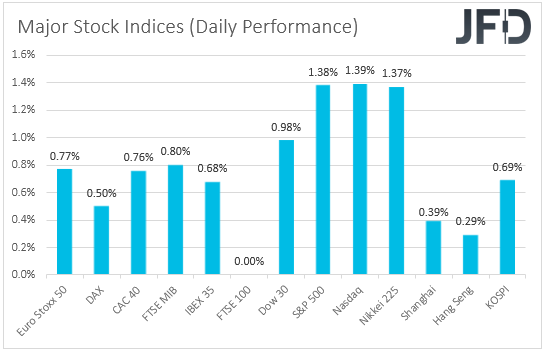
The latest rebound in risky assets was activated last week by new reports confirming that the Omicron coronavirus variant, although more transmissive than its predecessors, leads to fewer hospitalizations and deaths. Despite US airlines cancelling or delaying thousands of flights over the past few days due to the pandemic, several cruise ships cancelling stops after outbreaks on-board, and China reporting its highest daily rise in COVID cases in 21 months, investors may have remained optimistic that a spike in Omicron cases may not necessarily mean new restrictions, as it may not lead to that many hospitalizations. However, there is also the other side of the coin. The outbreak of the Omicron variant doesn’t mean that other, more deadly stains, like the Delta, are off the map. And what’s more, several nations may be waiting for the holiday season to end before imposing new restrictions. Some say that stocks may have been also boosted by a Mastercard Inc survey, which showed a substantial rise in US holiday season retail sales. But if this was the case, wouldn’t the dollar be stronger as well?
In our view, last week’s optimism, combined with an empty agenda and thin liquidity this week may have set the stage for the so-called “Santa rally”, and maybe this is what we are experiencing now. Absent any surprising and shocking headlines, we believe that this could continue until the end of the week. However, as we noted yesterday, we are reluctant to call for a long-lasting recovery. With several nations around the globe perhaps waiting to tighten restrictions after the holiday season, and most major central banks being in the process of removing, and not adding stimulus, due to extremely high inflation, we cannot rule out some setbacks after the turn of the year.
Nasdaq 100 – Technical Outlook
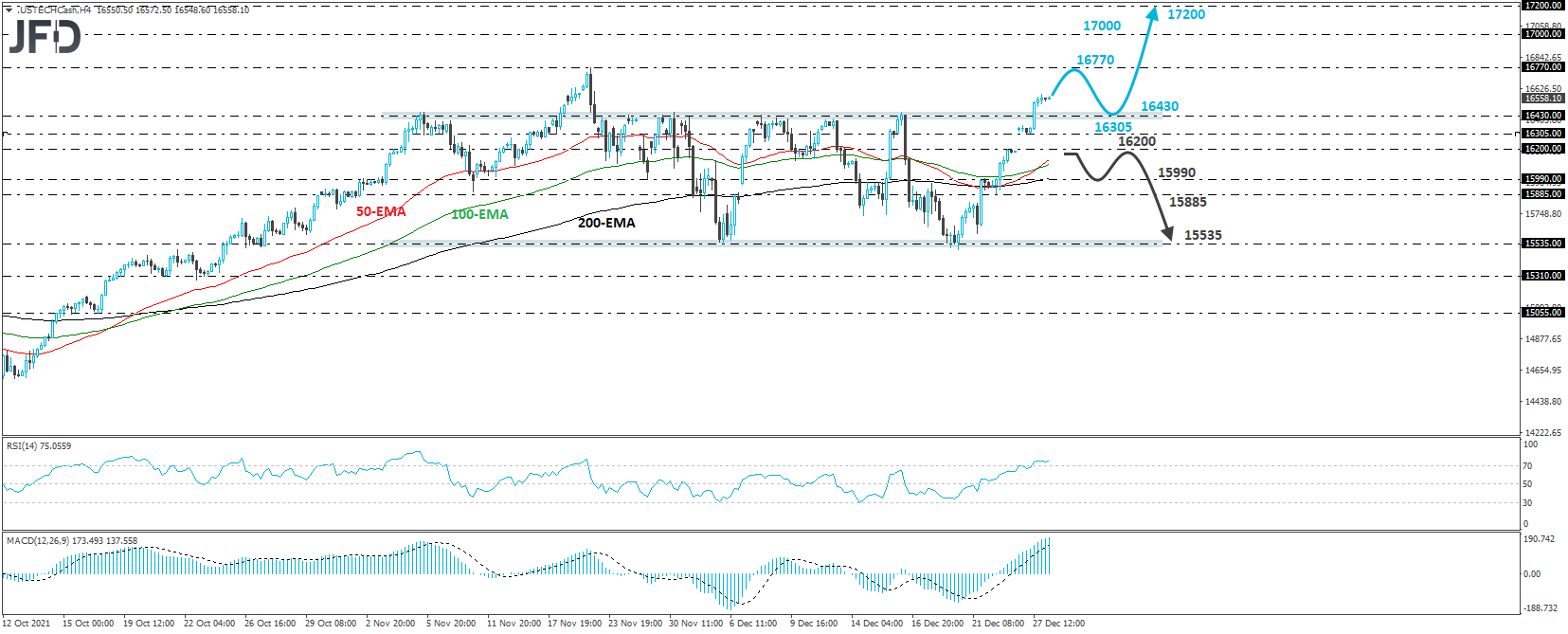
The Nasdaq 100 cash index moved higher yesterday, breaking above the very important resistance zone of 16430, which acted as the upper bound of the sideways range that had been containing most of the price action since October 27th. In our view, this keeps the door open for further advances, even for new record highs.
We believe that the bulls will soon target the all-time high of the index, at 16770, hit on November 22nd, the break of which will take them into uncharted territory. The next territory to consider as a resistance may be the psychological zone of 17000, and if they don’t stop there, we may see them reaching the 17200 territory.
On the downside, a dip back below 16200 could confirm the index’s return back within the prior sideways range, between 15535 and 16430. The bears may then get encouraged to dive towards the 15990 or 15885 barrier, marked by the inside swing high of December 21st, and the low of the day after. If they don’t stop there, we could see them pushing towards the lower end of the range at 15535, near the low of December 20th.
NZD/JPY – Technical Outlook
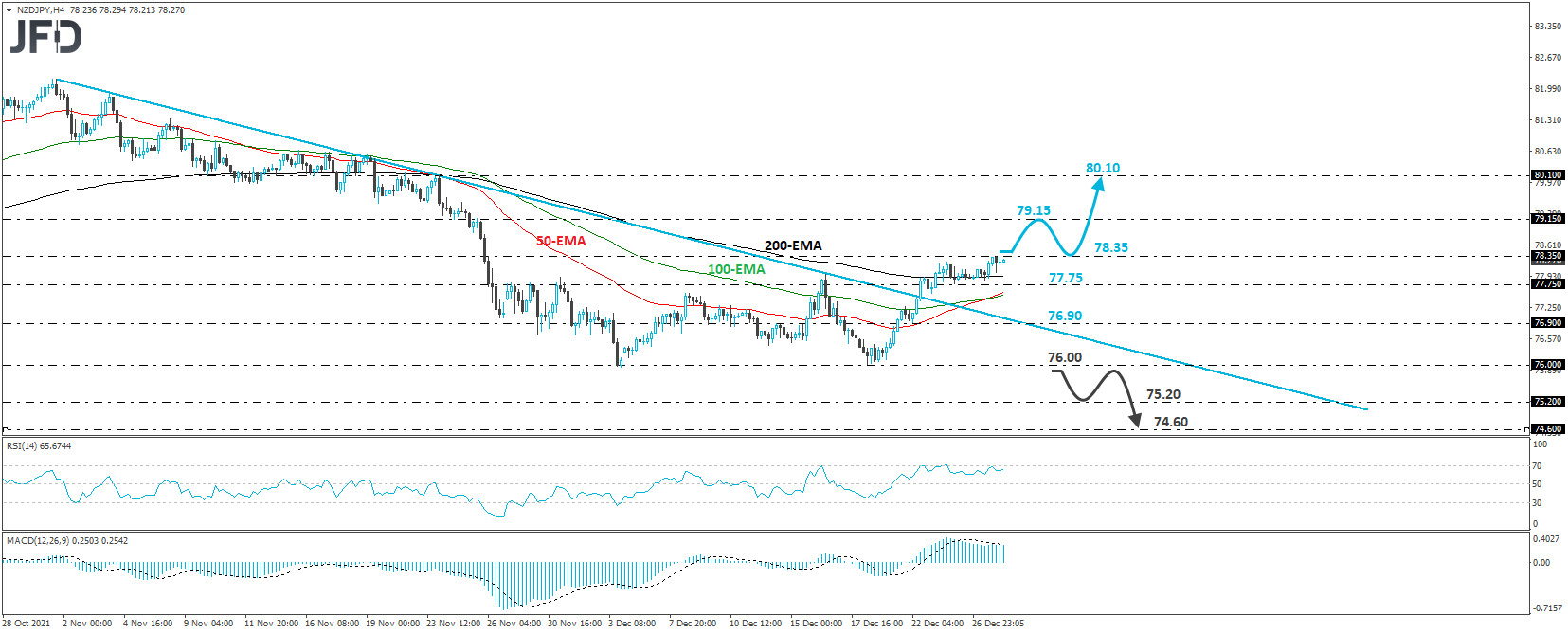
NZD/JPY traded somewhat higher yesterday, to hit resistance at 78.35. Overall, the pair has been trading above the prior downside line drawn from the high of November 1st, since December 22nd, something suggesting a somewhat positive near-term picture.
Even if the rate pulls back somewhat, as long as it stays above that prior downside line, we would see decent chances for the bulls to tack charge again and aim for another test at 789.35. If they are strong enough to break higher, we could see them targeting the inside swing low of November 24th, at 79.15. If they don’t stop there either, their next aim may be the 80.10 territory, defined as a resistance by the high of that same day.
We will turn bearish again upon a dip below the key support zone of 76.00. The rate will not only be back below the aforementioned downside line, but it will also confirm a forthcoming lower low. The next support may be the 75.20 barrier, marked by the inside swing high of August 20th, the break of which could trigger extensions towards the low of that day, at 74.60.
As for Today’s Events
The only release worth mentioning on today’s agenda is the Conference Board consumer confidence index for December, but no forecast is available.
Disclaimer:
The content we produce does not constitute investment advice or investment recommendation (should not be considered as such) and does not in any way constitute an invitation to acquire any financial instrument or product. The Group of Companies of JFD, its affiliates, agents, directors, officers or employees are not liable for any damages that may be caused by individual comments or statements by JFD analysts and assumes no liability with respect to the completeness and correctness of the content presented. The investor is solely responsible for the risk of his investment decisions. Accordingly, you should seek, if you consider appropriate, relevant independent professional advice on the investment considered. The analyses and comments presented do not include any consideration of your personal investment objectives, financial circumstances or needs. The content has not been prepared in accordance with the legal requirements for financial analyses and must therefore be viewed by the reader as marketing information. JFD prohibits the duplication or publication without explicit approval.
CFDs are complex instruments and come with a high risk of losing money rapidly due to leverage. 68.02% of retail investor accounts lose money when trading CFDs with the Company. You should consider whether you understand how CFDs work and whether you can afford to take the high risk of losing your money. Please read the full Risk Disclosure.
Copyright 2021 JFD Group Ltd.