


Following a very eventful weekend in the Brexit land, this week starts with elections in Canada. PM Trudeau’s Liberal Party is expected to win but with a minority. In terms of central banks, the Norges Bank, the Riskbank and the ECB will decide on their policies on Thursday. All of them are expected to stand pat, but it would be interesting to see what kind of information we will get with regards to their future plans. Ahead of Draghi’s last gathering as ECB Chief, we will get the preliminary Euro area PMIs for October.
Over the weekend, the UK Parliament decided to delay the vote over the new Brexit deal, something that obligated PM Johnson to ask the EU for a new extension. The UK PM sent the request, but unsinged and accompanied by another letter – this one signed – arguing against any delay. Now, the ball is in the EU’s court and market participants will be sitting on their hands in anticipation of what the response will be.
On Monday, the calendar appears to be empty, with no major economic releases scheduled. That said, we have elections in Canada. PM Trudeau’s Liberal Party expected to return to office, according to polls, but only with a minority. If this is the case, he may find it hard to push through legislations, as he would have to work with opposition parties in order to achieve so.
On Tuesday, it will be a holiday in Japan and thus markets there will be closed. Elsewhere, we get Canada’s retail sales for August and the US existing home sales for September. With regards to Canada’s retail sales, the headline rate is forecast to have remained unchanged at +0.4%, while the core one is expected to have rebounded to +0.1% mom from -0.1%. US existing home sales for September are forecast to have declined 0.7% mom after rising 1.3% in August.
On Wednesday, the only release worth mentioning comes during the Asian morning and it is New Zealand’s trade balance, which is expected to show a narrowing deficit.
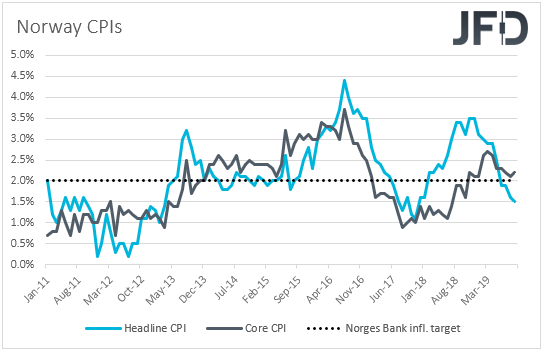
Thursday becomes a notably busier day, with three central banks scheduled to decide on their interest rates: The Norges Bank, the Riksbank and the ECB. Kicking off with the Norges Bank, at its last meeting, the Bank decided to increase rates by 25bps and noted that they will most likely remain at this level in the coming period. Since then, CPI data for September showed that the headline rate ticked down to +1.5% yoy from +1.6%, while the core one rose to 2.2% from 2.1%. Both rates stood slightly above their respective projections in the Bank’s latest Monetary Policy Report, and thus, we don’t expect this meeting to result in any fireworks. We just expect officials to reiterate that interest rates are likely to stay stable for a while.
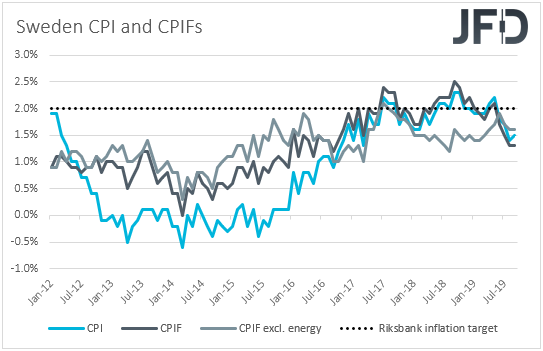
Passing the ball to the Riksbank, when it last met, the world’s oldest central bank decided to keep interest rates unchanged and maintained the view that they will be increased further towards the end of the year or the beginning of the next one. Sweden’s latest inflation data showed that the CPI rate ticked up to +1.5% yoy from +1.4% in August, instead of sliding to +1.3% as the forecast suggested, while the CPIF one held steady at +1.3% yoy. The forecast was for the CPIF rate to tick down to +1.2%. The core CPIF rate, which excludes the volatile items of energy, also held steady, at +1.6% yoy. The Swedish Krona rallied when this data set was out, suggesting that market participants may have revived bets that officials can still push the hike button before the turn of the year. Thus, it would be interesting to see whether this will be the case, and if so, whether they will give a more specific timing.
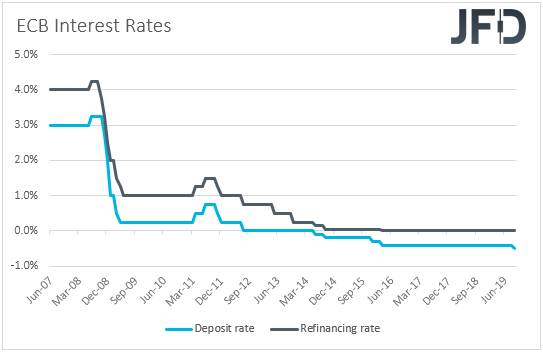
Last but not least, we have the ECB. Back in September, the Bank decided to cut its deposit rate by 10bps, to -0.50%, and announced a restart of its QE program from November 1st, at a monthly pace of EUR 20bn, with the new round of purchases being open-ended. The forward guidance was changed to an open-ended one as well. While previously the Governing Council has noted that interest rates are likely to stay “at their present or lower levels at least through the first half of 2020”, this time, they noted that they expect rates to stay at present or lower levels until they see inflation robustly converging toward their target.
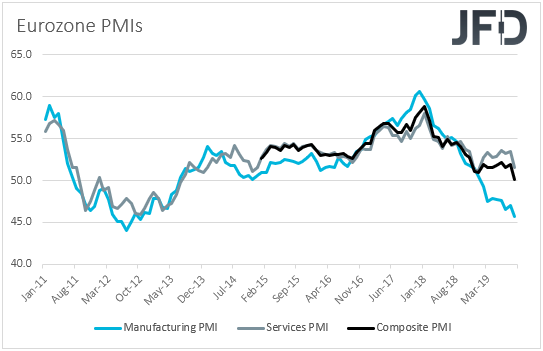
Since then, PMIs for September disappointed, while both the headline and core CPI rates for the month stood well below the Bank’s objective of “below, but close to 2%”. Thus, investors may be on the lookout for clues as to whether the ECB remains ready to act again if needed. At the press conference following the last decision, President Draghi said clearly that the Governing Council “continues to stand ready to adjust all of its instruments as appropriate to ensure that inflation moves towards its aim in a sustained manner,” and we expect him to reiterate that view. However, given that this will be his last gathering as ECB Chief, we don’t believe that he will give any specific hints with regards to further easing measures, as he would like to avoid limiting the options and choices of his successor, Christine Lagarde.
As they try to figure out what the ECB’s steps will be in the post-Draghi era, investors may also pay extra attention to the preliminary Euro-area PMIs for October, which come out ahead of the ECB decision. Both the manufacturing and services indices are expected to have risen somewhat, something that would drive the composite index up to 50.4 from 50.1.
We get preliminary Markit PMIs for October from the US as well. The manufacturing index is expected to have declined to 50.7 from 51.1, while the services one is anticipated to have remained unchanged at 50.9. Strangely, the composite index is forecast to have risen to 51.6 from 51.0. Durable goods orders and new home sales, both for September are also coming out. Both the headline and core durable goods rates are expected to have declined to -0.7% mom and -0.1% mom, from +0.2% and +0.5% respectively, while new home sales are forecast to have slid 0.5% mom after rising 7.1% in August.
Finally, on Friday, during the European morning, we get the German Ifo Survey for October. The current assessment index is expected to have increased to 97.9 from 98.5, while the expectations one is anticipated to have held steady at 90.8. That said, bearing in mind that both the current conditions and economic sentiment indices for the month declined, we see the risks surrounding the Ifo forecasts as tilted to the downside.
Disclaimer:
The content we produce does not constitute investment advice or investment recommendation (should not be considered as such) and does not in any way constitute an invitation to acquire any financial instrument or product. The Group of Companies of JFD, its affiliates, agents, directors, officers or employees are not liable for any damages that may be caused by individual comments or statements by JFD analysts and assumes no liability with respect to the completeness and correctness of the content presented. The investor is solely responsible for the risk of his investment decisions. Accordingly, you should seek, if you consider appropriate, relevant independent professional advice on the investment considered. The analyses and comments presented do not include any consideration of your personal investment objectives, financial circumstances or needs. The content has not been prepared in accordance with the legal requirements for financial analyses and must therefore be viewed by the reader as marketing information. JFD prohibits the duplication or publication without explicit approval.
75% of the retail investor accounts lose money when trading CFDs with this provider. You should consider whether you can afford to take the high risk of losing your money. Please read the full Risk Disclosure.