


Fears over the coronavirus turning into a pandemic kept investors’ morale subdued. For the first time, cases outside China outpaced those in China. Equities, risk-linked assets, and oil prices declined, with investors of the latter biting their nails over whether OPEC and its allies will cut production deeper (or not) when they meet next week. Among the G10 currencies, the euro gained on expectations of fiscal support, the pound tumbled for the exactly opposite reason, while the Aussie, apart from the risk-off environment, also felt the heat of disappointing business investment data.
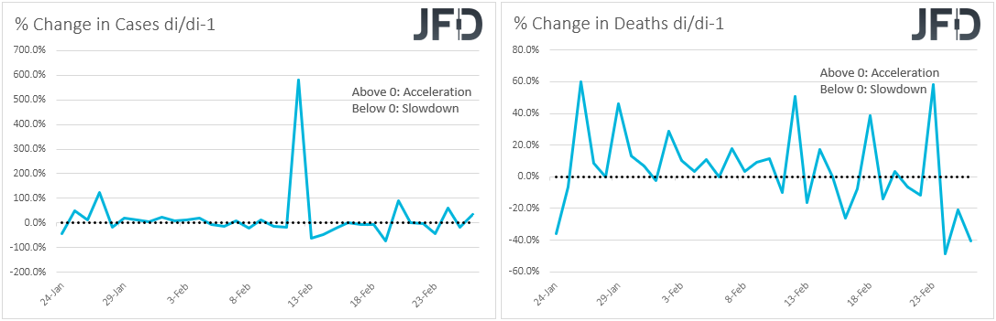
Virus Cases Outside China Surpass Cases in China
The dollar traded mixed against the other G10 currencies on Wednesday and during the Asian morning Thursday. It gained against AUD, GBP, CAD, NOK and NZD in that order, while it underperformed versus EUR, CHF, JPY and SEK.
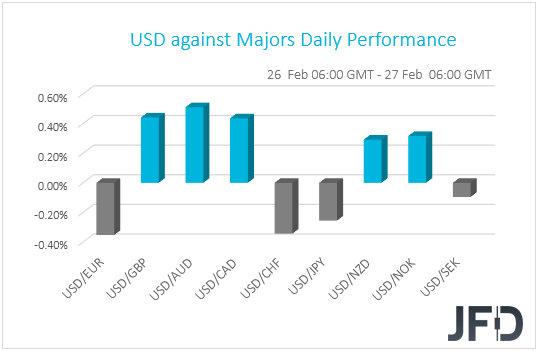
The performance in the FX sphere suggests that investors kept short-selling equities and risk-linked assets, in favor of the safe havens. However, looking at the equity world, we see that major EU indices traded unchanged or positive. That said, remember that on Tuesday morning we noted that even if equities rebound, we will treat such a move as a corrective bounce. Indeed, this appeared to have been the case, as the relief was short-lived.
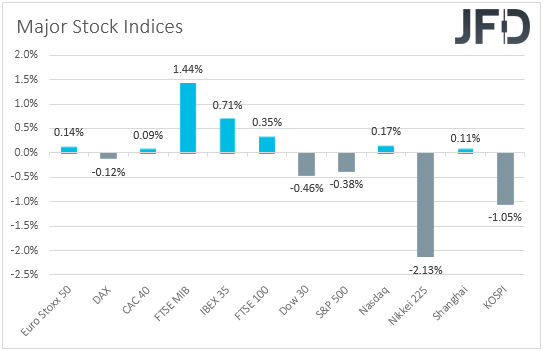
During the US session, fears over the coronavirus turning into a pandemic resurfaced, after New York health officials said that they were monitoring 83 people who traveled to China and may have been infected. Both the S&P 500 and DJIA ended the day 0.38% and 0.46% lower respectively. That’s a much slower pace than Tuesday, but still marks their fifth consecutive day in negative waters. Nasdaq was the exception, finishing slightly positive (0.17%).
With the number of new cases outside China surpassing those in China for the first time since the outbreak, the negative investor morale rolled over into the Asian session today. Oddly enough, or perhaps due to China’s lower number, Shanghai’s Composite gained 0.11%. However, Japan’s Nikkei 225 and South Korea’s KOSPI fell 2.13% and 1.05% respectively.
Looking at the numbers on a global scale, although deaths remained in slowdown mode, cases returned in acceleration, suggesting that the worst is not behind us yet. Thus, we will stick to our guns that with the virus now feared that it will have greater and longer impact on the global economy than previously believed, there is still room for equities and risk linked currencies, like the Aussie and the Kiwi, to keep sliding, while safe havens, like the yen, the franc, gold and bonds may continue to be the beneficiaries.
Oil prices fell as well, with Brent and WTI losing 3.86% and 2.99% respectively yesterday, and kept declining today during the Asian day as well. Increasing worries over a pandemic raised speculation that crude demand will slump more than previously anticipated. Participants may also believe that OPEC and its allies have to proceed with deeper production cuts when they meet next week. However, Saudi Arabia’s energy minister said recently that the cartel has not decided yet on whether it should extend or modify its current agreement, adding further pressure on the black liquids.
Brent Oil – Technical Outlook
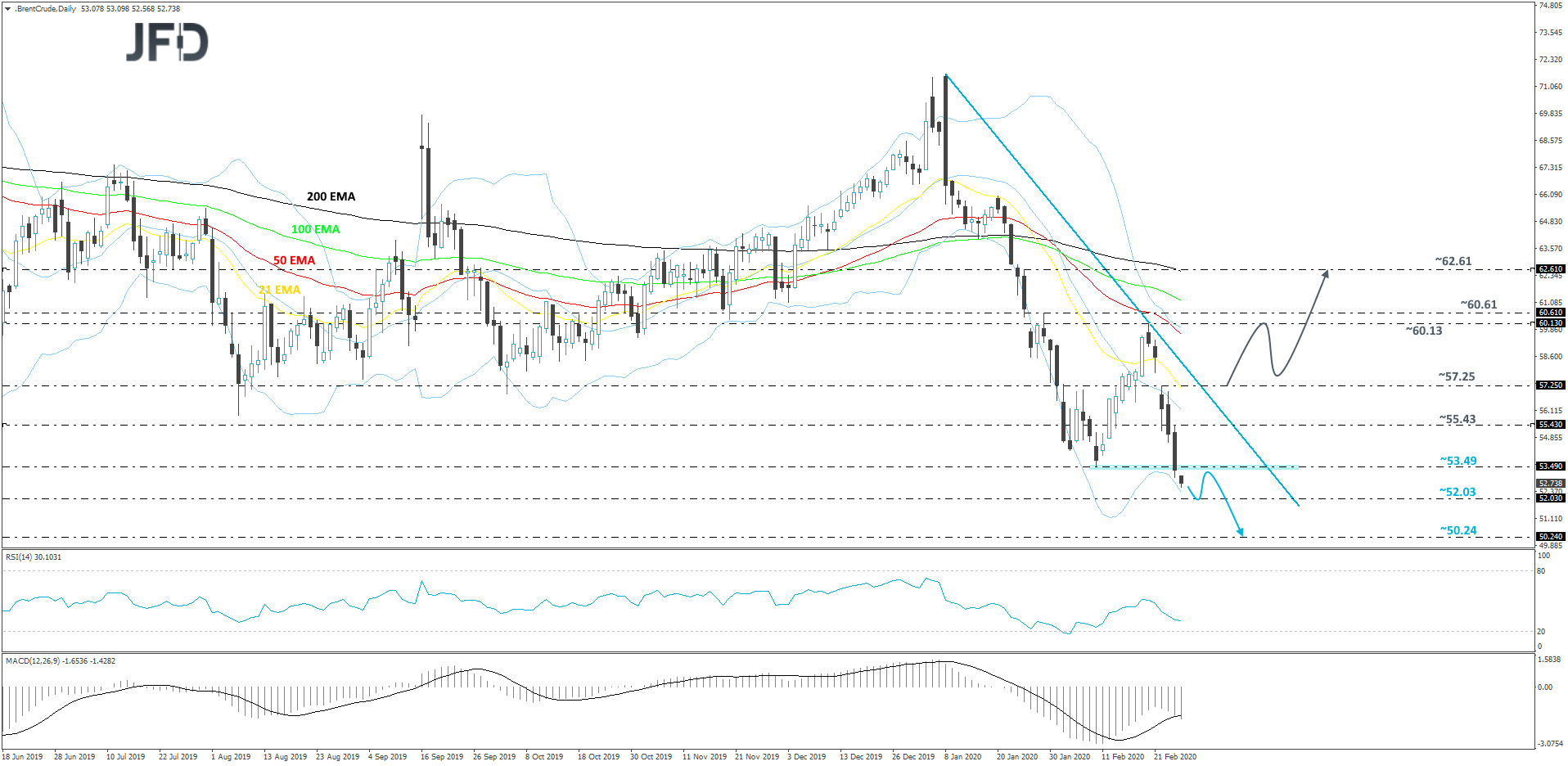
Yesterday, Brent oil broke below its key support, near the 53.49 level, which was the previous lowest point of February. Given the recent slide, we can now draw a short-term tentative downside resistance line, connecting the two peaks of January 8th and February 20th. Our oscillators, the RSI and the MACD, started pointing lower again and thus, for now, we will take a bearish stance and continue aiming slightly lower.
A further move down may bring the price to the 52.03 territory, which is the low of December 28th, 2018. Initially, we may see a hold-up around there, which could help Brent oil to bounce back slightly. However, if the commodity continues to trade, either below the previously-discussed 53.49 hurdle, or the aforementioned downside line, we will stay bearish. A slide back to the 52.03 obstacle and its break would confirm another lower low and could clear the way to the 50.24 level, marked by the lowest point of 2018.
In order to examine a possible move higher, at least in the near-term, we would like to see a break of the aforementioned downside line and a price-rise above the 57.25 barrier, marked by the current high of this week. This way we will aim for the next strong resistance area, between the 60.13 and 60.61 levels, which are the highs of February 20th and January 29th respectively. If that area is just seen as a temporary pit-stop for the bulls, its break may lead to the 62.61 zone, marked by the high of January 24th. Around there Brent oil would also test the 200-day EMA.
EUR the Main G10 Gainer, AUD the Main Loser, GBP the Second Loser in Line
Back to the currencies, the euro was the main gainer among the G10s, coming under buying interest after reports suggested that Germany’s finance ministry is seriously considering to boost fiscal spending, due to growing pressure to support the nation’s sluggish economy. The euro had been in a sliding mode from the beginning of the month and up until last Thursday, perhaps on speculation that the soft economic data out of the Euro area may put pressure on ECB policymakers to ease further. However, fiscal stimulus will alleviate some of that pressure, and that’s why the euro recovered decently yesterday.
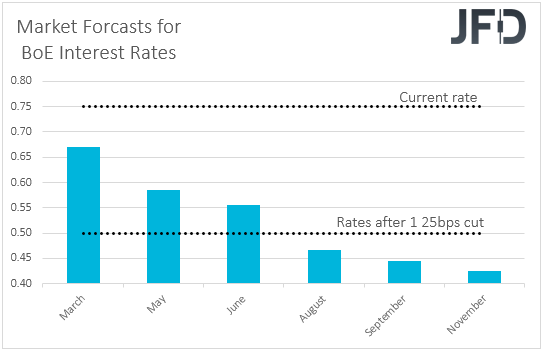
The opposite story stands for the pound. Remember that when Sajid Javid resigned from the position of Chancellor of the Exchequer, the British currency gained on speculation that his successor, Rishi Sunak, will push for more spending at the March budget announcement and thereby lessen the need for a BoE rate cut. However, yesterday reports pointed to a potential delay of such decision. Given that a fiscal support in the UK is now in doubt, investors may have brought forth their bets with regards to a BoE rate cut and that’s why the pound slid, taking the second place among the losers. According to the CME MPC futures, they are now more than fully pricing in a rate cut to be delivered in August.
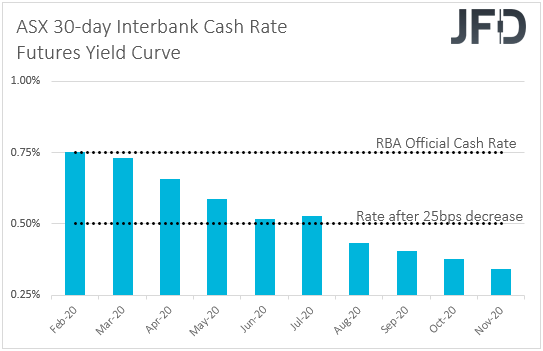
The Aussie was the main loser. Apart from the risk-off trading, the commodity-linked currency may have also been pressured by data showing that business investment unexpectedly fell during the last three months of 2019, raising concerns that GDP growth data, due out next week, may reveal a slowdown, something which may prompt the RBA to cut interest rates earlier than previously anticipated. According to the ASX 30-day interbank cash rate futures implied yield curve, a quarter-point rate decrease is now almost fully priced in for June.
All we mentioned above make us believe that EUR/GBP may have decent chances to continue drifting higher, while the Aussie is likely to continue underperforming, especially if sentiment continues to deteriorate. If this is the case, we would prefer to exploit any Aussie weakness against the safe havens, like the yen and the Swiss franc. Having said that though, we will still hold some reservations with regards to the yen as it could take off its safe-haven suit again if concerns over the performance of the Japanese economy resurface.
EUR/GBP – Technical Outlook
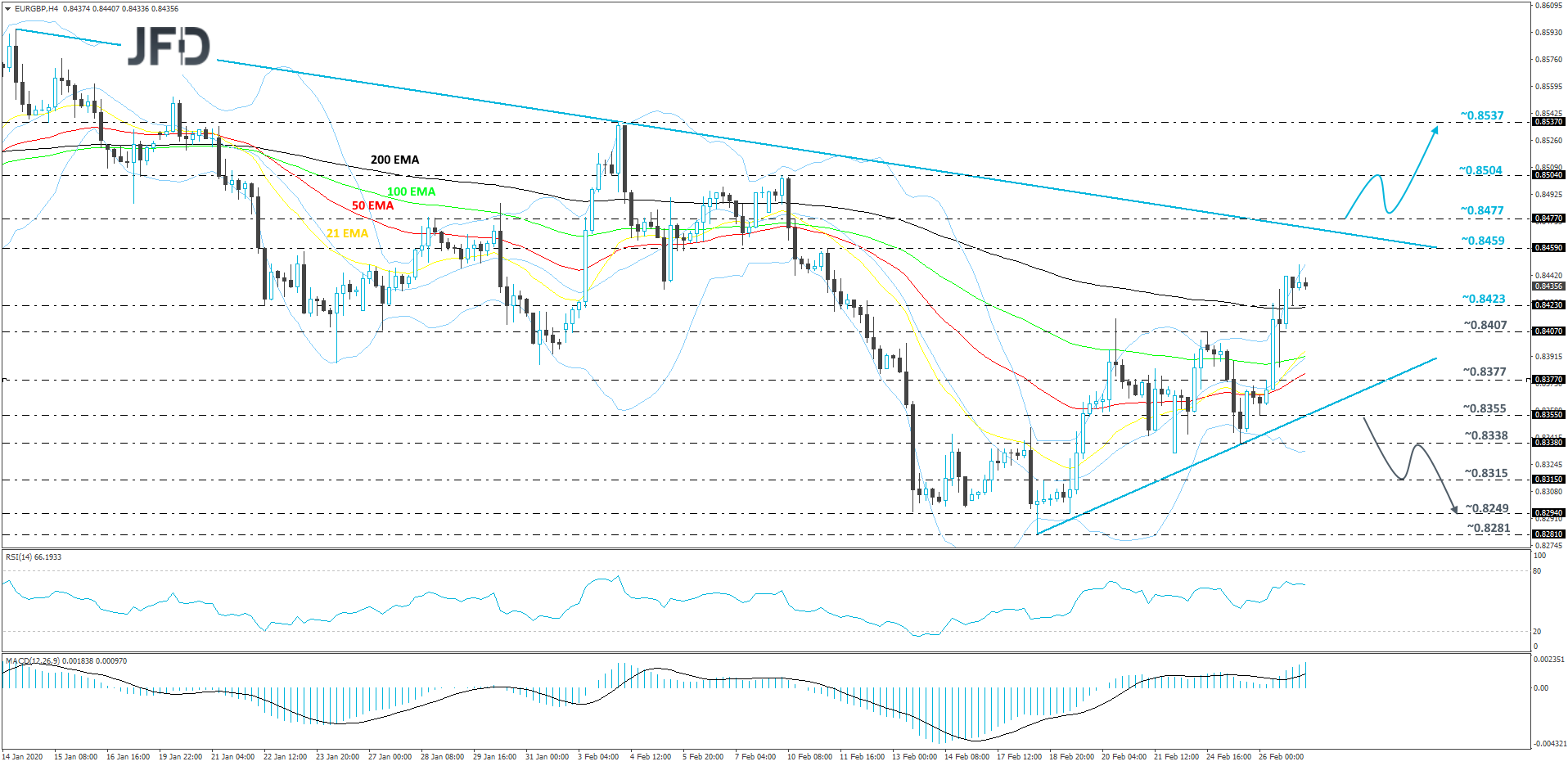
EUR/GBP made a decent move to the upside yesterday, lifting itself above the 200 EMA on the 4-hour chart. However, we can see that the pair remains stuck between two of its tentative lines, a short-term downside one taken from the high of January 14th and a short-term upside one drawn from the low of February 18th. As long as the rate continues to trade between those two line, we will stay neutral and wait for a break through one of them before considering a further directional move.
If the aforementioned downside line breaks and the rate climbs above the 0.8477 barrier, which is an intraday swing high of February 10th, then we may get a bit more comfortable with further extensions to the upside. EUR/GBP might then travel to the 0.8504 hurdle, a break of which could open the door for a push to the 0.8537 level, marked by the highest point of February.
Alternatively, to aim for lower areas more comfortably, we would like to see a break of the previously-mentioned upside line and a drop below the 0.8355 zone, which is yesterday’s low. This way, the remaining bulls might get spooked from the field and allow the bears to take the steering wheel for a while. The rate may then slide to the 0.8338 obstacle, or the 0.8315 hurdle, which is an intraday swing high of February 18th. If the selling doesn’t stop there, a further move down could set the stage for a test of the 0.8294 level, marked near the lows of February 13th and 19th.
As for Today’s Events
During the afternoon, we get the US durable goods orders for January, and the second estimate of the US GDP for Q4. With regards to durable goods, headline sales are expected to have declined 1.5% mom after rising 2.4% the month before, while the core rate is anticipated to have risen to -0.1% mom from -0.8%.
The second estimate of the US GDP is expected to confirm its initial estimate, namely that the economy grew +2.1% qoq SAAR, the same pace as in Q3. In our view, even if we get a small deviation, the market is unlikely to react massively on this release. After all, we already have models pointing to how the economy has been performing during the first quarter of 2020. The Atlanta fed GDPNow points to a growth rate of 2.6%, while the New York Nowcast suggests that the economy has been growing at a 2.0% pace. In any case, the quarter is not over yet, and those numbers are still subject to revisions. The US pending home sales for January and the initial jobless claims for last week are also coming out.
As for tonight, we get the usual end-of-month data dump from Japan. Both the unemployment rate and the jobs-to-applicants ratio for the month of January are expected to have held steady at 2.2% and 1.57 respectively, while both the preliminary industrial production and retail sales for the month are anticipated to have declined at a faster pace than in December. Exactly, industrial production is expected to have tumbled 9.5% yoy after sliding 3.1% in December, while retail sales are forecast to have declined 3.3% yoy after falling 3.0%. The Tokyo CPIs for February are also coming out. The headline rate is expected to have increased to +0.8% yoy from +0.6%, while the core one is anticipated to have remained unchanged at +0.9% yoy.
With regards to the speakers, we have four on today’s agenda: ECB Vice President Louis de Guindos, ECB Executive member Philip Lane, BoE Deputy Governor for financial stability Jon Cunliffe, and Chicago Fed President Charles Evans.
Disclaimer:
The content we produce does not constitute investment advice or investment recommendation (should not be considered as such) and does not in any way constitute an invitation to acquire any financial instrument or product. The Group of Companies of JFD, its affiliates, agents, directors, officers or employees are not liable for any damages that may be caused by individual comments or statements by JFD analysts and assumes no liability with respect to the completeness and correctness of the content presented. The investor is solely responsible for the risk of his investment decisions. Accordingly, you should seek, if you consider appropriate, relevant independent professional advice on the investment considered. The analyses and comments presented do not include any consideration of your personal investment objectives, financial circumstances or needs. The content has not been prepared in accordance with the legal requirements for financial analyses and must therefore be viewed by the reader as marketing information. JFD prohibits the duplication or publication without explicit approval.
CFDs are complex instruments and come with a high risk of losing money rapidly due to leverage. 76% of retail investor accounts lose money when trading CFDs with the Company. You should consider whether you understand how CFDs work and whether you can afford to take the high risk of losing your money. Please read the full Risk Disclosure.
Copyright 2020 JFD Group Ltd.