


Some major European bourses closed in the red, yesterday, possibly due to some profit taking after the recent rally. DAX was monitored carefully, as after hitting a new all-time high, the German index made its way back down to the psychological 14000 area. That said, it managed to close the day slightly above it. The US indices initially showed modest gains during yesterday’s trading session. However, they reversed south before the closing bell, ending their sessions fractionally in the red. This might have been seen as a slight correction lower, before another possible leg of buying. Investors are still hoping to see the stimulus bill to pass through Congress. But there is also a lot of criticism on that aid package, which is gaining more support among various economists.
Stimulus Package Obstacles
Yesterday’s growth might have been on the modest side due to increasing concerns over the proposed stimulus package and its longer-term effects on the economy. The stimulus would include $1trn as direct payments to taxpayers. The $400bln will be given to fight Covid-19, with the money going towards vaccine production and distribution. Biden argues that more spending is needed, in order to tackle negative effects of the pandemic. Critics say that, because this bill would only help in the very short-run, the longer-term outlook could become gloomier, as inflation may start rising way too quickly. However, the other issue here is, how those households will spend those funds and will that spending actually stimulate the economy? If you are an individual, who has earned up to $75000 in 2019/2020 tax year, you should be entitled to a $1400 check from the government. The amount can increase, if you have dependants. But the issue is that some of these people are not unemployed, as they continue working from home. But others, who will receive the funds, are actually unemployed. And they will “burn” through the government money very quickly, as most of them have outstanding debt and still struggling to find jobs. Especially, people who are involved in hospitality and tourism industries. The only help and relief for them would be, if the government would open up those sectors as quickly as possible. Otherwise, this will be as effective as burning a camp fire with banknotes. It will help you warm up at first, but only for a short period of time.
As mentioned in our previous daily report, initially, markets might welcome Biden’s stimulus bill, however, if it becomes clear that more financial support is needed, this could make investors worry again. Also, if the current government continues to struggle in its fight against the coronavirus, it might quickly weigh in on the financial market in a negative way. This could result in equities taking a hit and indices falling. For now, the news, which continues to hit the wires is mainly positive and that means markets might remain within the risk-on environment.
Inflation Figures On The Agenda
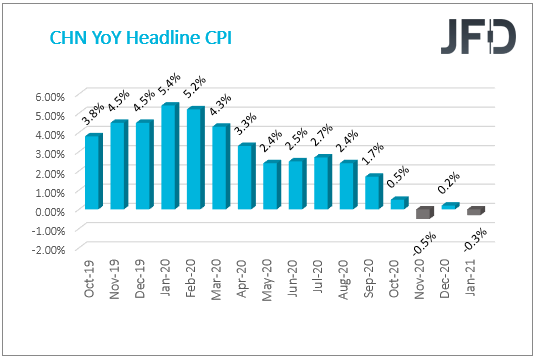
Wednesday will be a busier day than the previous two, as some investors will be keeping a close eye on the economic calendar. China kicked off the day with its MoM and YoY inflation readings for the month of January. The MoM figure improved, going from the previous +0.7% to +1.0%, whereas the YoY figure had gone negative to -0.3%. This the third time since November 2009 that the number had gone negative. Recently, the November 2020 YoY figure was seen coming out at -0.5%. Let’s remind our readers that the PBOC’s inflation target is around +3.0%. It seems that this might be time for the Chinese central bank to go ahead with the rate cut, however, they are willing continue maintaining their rate at +3.85%, at least for a while more. Last time the Bank cut the rate was back in April 2020.
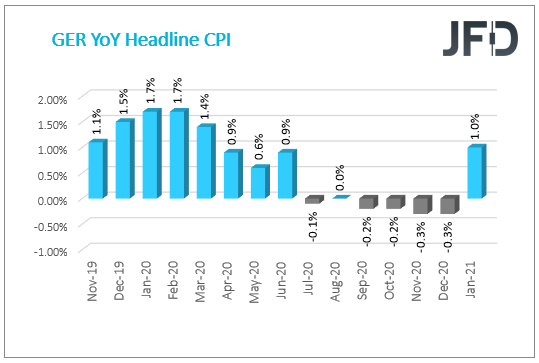
During the European morning, Germany and Norway released their MoM and YoY inflation numbers for the previous month. All German numbers came out with no surprises and just confirmed their initial expectations. The MoM rose from +0.5% to +0.8% and the YoY reading moved from -0.3% to +1.0%. This gave the common currency a slight boost. In addition to the headline readings, Norway released the core inflation numbers for the month of January. All figures managed to beat their initial forecast. This helped strengthen NOK against some of its major counterparts, including the euro, US dollar and neighbouring Swedish krona. During the previous month, the Norwegian headline YoY CPI number also moved higher, which was mainly driven by the rise in prices of transportation, furnishings, household equipment and routine maintenance. That might have been the result of a combination of increased spending during the holiday season and some coronavirus restrictions, where people were encouraged to remain indoors.
DAX – Technical Outlook
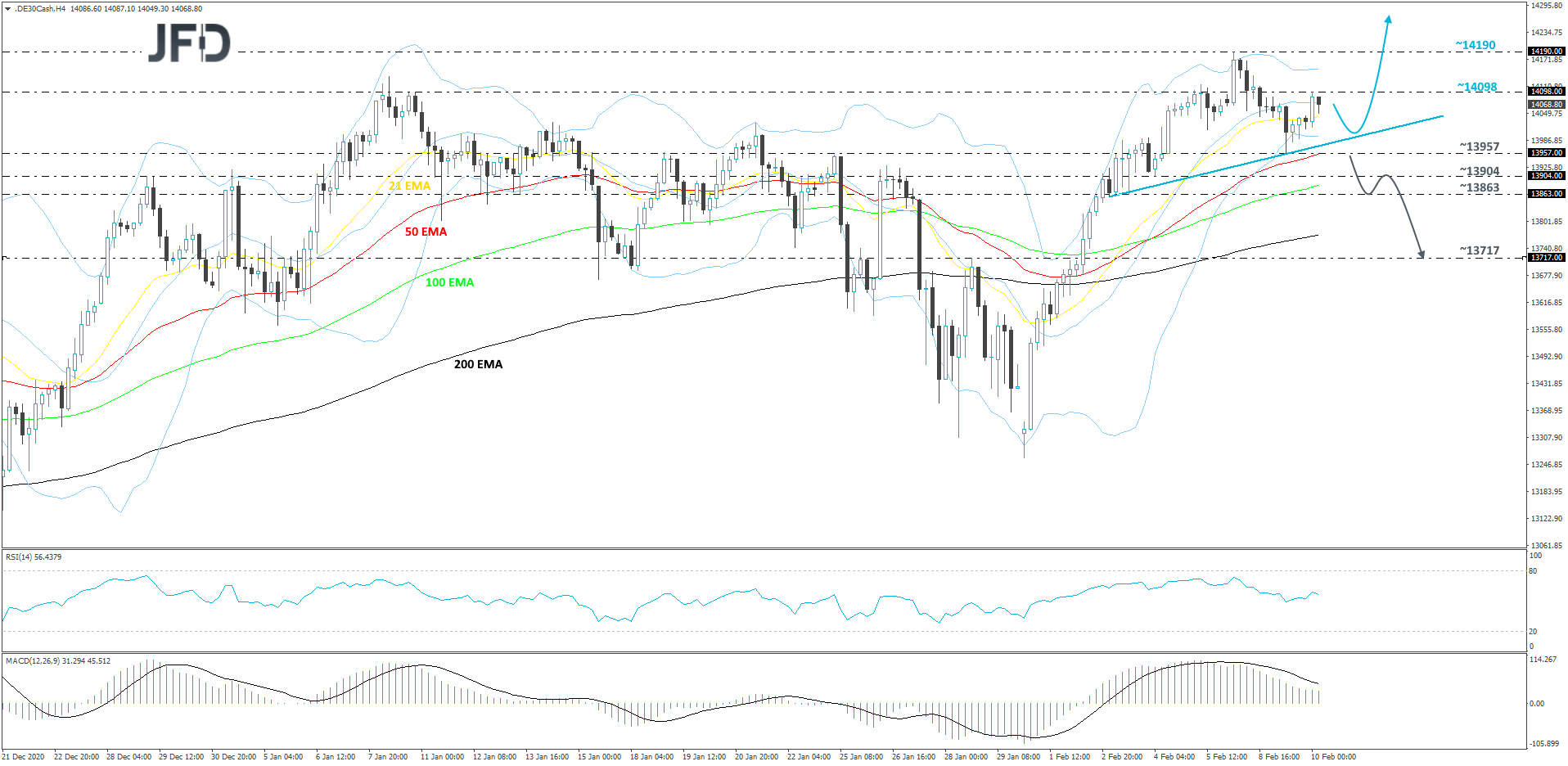
DAX continues to trade above a short-term tentative upside line taken from the low of February 3rd. In addition to that, the German index remains above all of our EMAs on our 4-hour chart, which strengthens the bullish case, at least for now.
If the price stays above all of the EMAs and then climbs above 14098 barrier, which is the current high of today, that might attract a few more buyers into the game. Such a move could lead the index to the current all-time high, at 14190, a break of which would confirm a forthcoming higher high and place DAX into the uncharted territory.
Alternatively, if the previously-discussed upside line breaks and the price falls below the 13957 hurdle, marked by yesterday’s low, that could temporarily spook the bulls from the field. DAX might then travel to the 13904 obstacle, or to the 13863 zone, marked near the low February 3rd. The index may stall there for a bit, however, if the bulls are still nowhere to be found, this could result in a further decline. That’s when we will aim for the 13717 level, marked by the inside swing high of January 28th.
We will also watch out for Sweden’s Riksbank interest decision. The expectation is for the rates to remain the same, at 0.0%. During the last meeting in November, Sweden’s central bank kept the benchmark rate at the same 0.0%, due to concerns of possible further economic downturn caused by the pandemic. The lower rate is expected to help support the Swedish economy, together with the extension and expansion of the Riksank’s asset purchases up to December 2021.
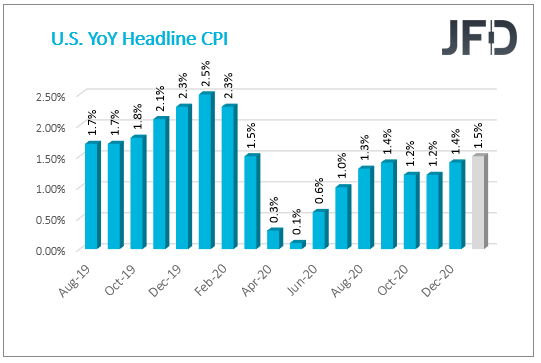
It will be the US turn to show how their inflation figures performed during the month of January. The core and the headline MoM and YoY figures will be monitored carefully. The readings are believed to come out mixed. The core MoM and the headline YoY figures are forecasted to have improved, where the core YoY and the headline MoM are expected to have declined. We will keep a close eye on the headline YoY number, which also includes food and energy prices. The forecast currently sits at +1.5%, which would be a slight improvement from the previous +1.4%. The Federal Reserve is still hoping to see inflation around +2.0% over the longer run. As per the FOMC’s most recent statement: “With inflation running persistently below this longer-run goal, the Committee will aim to achieve inflation moderately above 2 percent for some time so that inflation averages 2 percent over time and longer‑term inflation expectations remain well anchored at 2 percent. The Committee expects to maintain an accommodative stance of monetary policy until these outcomes are achieved.”
NZD/USD – Technical Outlook
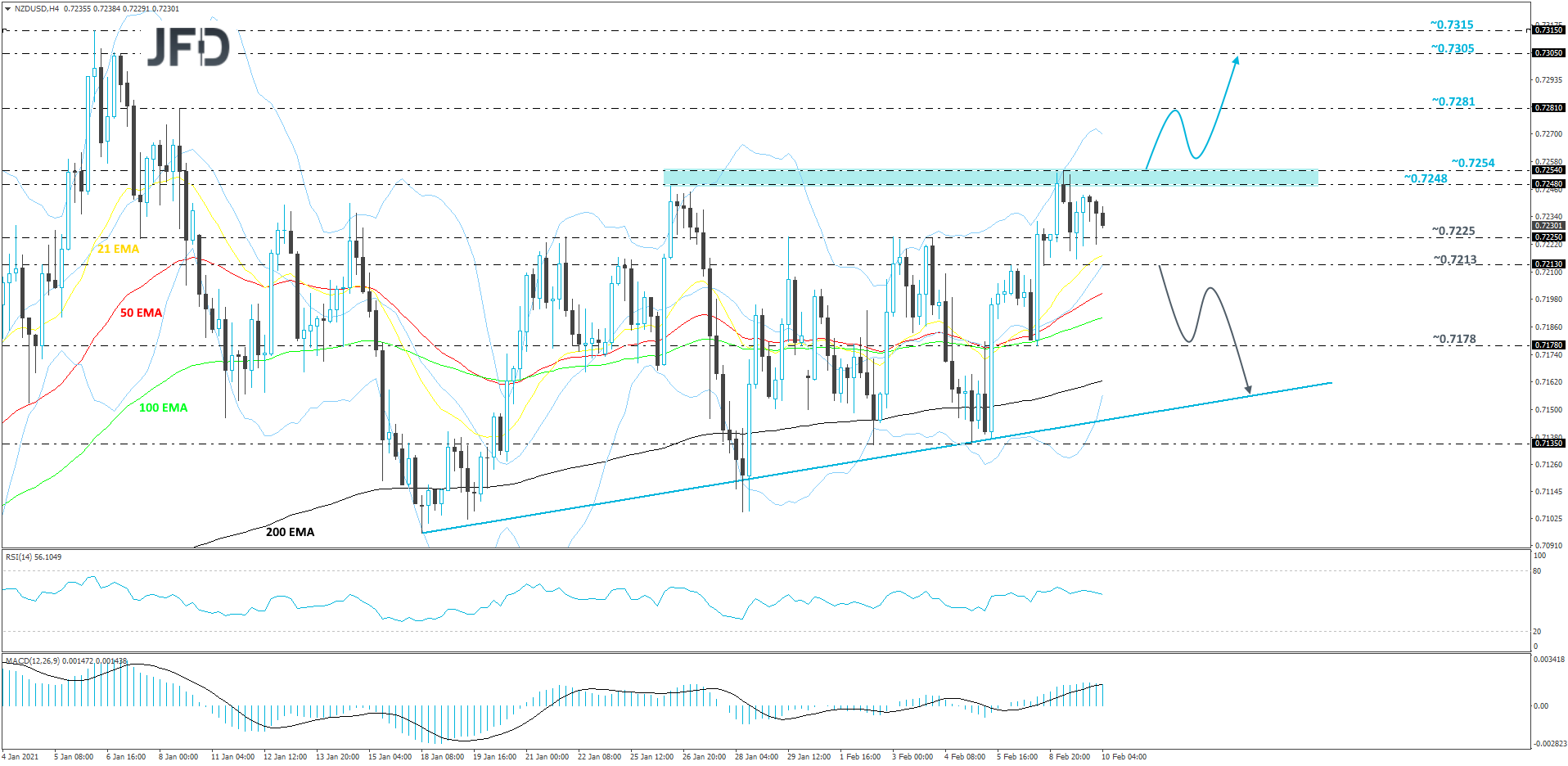
After reversing higher at the end of last week, NZD/USD went all the way back to one of its key resistance areas between the 0.7248 and 0.7254 levels, marked by the highs of January 26th and February 9th. At the same time, the pair continues to balance well above its short-term tentative upside support line drawn from the low of January 18th. Although there is a good chance to see further advances in the near-term, to get slightly more comfortable with that idea, we would prefer to wait for a break above the 0.7254 barrier first. Until then, we will stay somewhat bullish.
If the pair goes ahead and breaks the above-mentioned 0.7254 barrier, marked by the current highest point of February, that will confirm a forthcoming higher high, possibly opening the door towards the 0.7281 hurdle, marked by the high of January 8th. If the buying doesn’t stop there, the next resistance area could be at 0.7305. That area is marked near the high of January 7th.
If the rate suddenly drops back below the 0.7213 hurdle, marked by the high of February 7th and an intraday swing low of February 8th, that may open the door for a larger correction lower. NZD/USD may then drift to the 0.7178 obstacle, where it could find a temporary hold-up. That said, if the sellers are still active, the next potential target might be the aforementioned upside line.
As For The Rest Of Today’s Events
In addition to the CPIs, the US will deliver the crude oil inventories number for the previous week. The figure measures the change in the number of oil barrels held by commercial US firms. If the number is greater than the previous, then this shows weaker demand. Currently, there is no forecast for that data set, but the past two readings were below zero, implying a rise in demand of crude oil. This might have supported the recent rise in WTI oil prices. Later on, investors will also keep an eye on the US federal budget announcement.
Disclaimer:
The content we produce does not constitute investment advice or investment recommendation (should not be considered as such) and does not in any way constitute an invitation to acquire any financial instrument or product. The Group of Companies of JFD, its affiliates, agents, directors, officers or employees are not liable for any damages that may be caused by individual comments or statements by JFD analysts and assumes no liability with respect to the completeness and correctness of the content presented. The investor is solely responsible for the risk of his investment decisions. Accordingly, you should seek, if you consider appropriate, relevant independent professional advice on the investment considered. The analyses and comments presented do not include any consideration of your personal investment objectives, financial circumstances or needs. The content has not been prepared in accordance with the legal requirements for financial analyses and must therefore be viewed by the reader as marketing information. JFD prohibits the duplication or publication without explicit approval.
CFDs are complex instruments and come with a high risk of losing money rapidly due to leverage. 79.07% of retail investor accounts lose money when trading CFDs with the Company. You should consider whether you understand how CFDs work and whether you can afford to take the high risk of losing your money. Please read the full Risk Disclosure.
Copyright 2021 JFD Group Ltd.