


Yesterday and today in Asia, we had, not one, not two, but four central bank decisions on our agenda. Those were the SNB, the BoE, the ECB, and the BoJ, with all of them sounding more hawkish, or less dovish, than expected, encouraging market participants to buy francs, pounds, euros, and yens.
Pound, Euro, Franc, and Yen, Gain after Their Bank’s Decisions
The US dollar slid against all the other major currencies on Thursday and during the Asian morning Friday, losing the most ground versus CHF, GBP, EUR, and JPY.
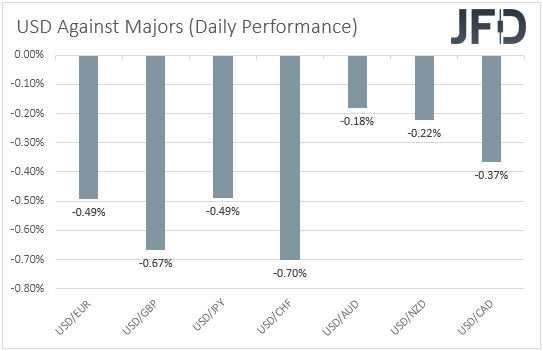
At first glance, the weakening of the US dollar and the strengthening of the British pound suggest a risk-on trading, while the strengthening of the franc and the yen point otherwise. However, taking a closer look, we see that the main gainers were the currencies the respective central banks of which announced their monetary policy decisions yesterday and today in Asia.
First of all, we had the SNB, which proceeded with no changes in its policy settings, neither in the accompanying statement. Officials reiterated for the umpteenth time that the Swiss franc remains highly valued and that they remain willing to intervene in the FX market as necessary. In the past, those statements were expected and thus, the market reaction was minimal. However, this time around, with EUR/CHF falling notably due to the uncertainty the new covid-related restrictive measures pose on European economies, some participants may have been expecting Swiss officials to strengthen their wording with regards to preventing the franc from gaining more. Thus, the outcome came as a disappointment to them and that’s why the franc kept marching north, ending the day as the main gainer among the majors.
Then, it was the BoE’s turn, with British officials surprising the markets for the second time in six weeks. At the November gathering, market participants were assigning an 80% chance for a rate increase, and instead policymakers refrained from acting. Now, the financial community was confident that due to the increasing covid cases and the new restrictive measures in the UK, the Bank may prefer to wait for a few more months before acting. Again, the Bank surprised investors and decided to push the hike button, lifting interest rates to 0.25% from 0.10%.
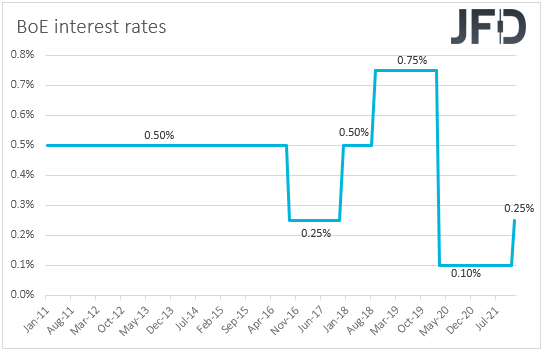
The Policy Committee voted 8-1 for raising rates, with the only dissenter being Silvana Tenreyro. In our view, this suggests that the Committee as a whole is more concerned over high inflation rather than a potential economic slowdown. After all, the Bank pointed to the likelihood of more modest tightening, with Governor Bailey adding that it is unclear whether Omicron would ease or add to inflationary pressures. According to media, investors are now pricing in three more quarter-point increases until September 2022, which suggests that the pound could stay supported for a while more, even against the US dollar. Remember that the Fed has yet to deliver its first rate increase, while it sees three hikes until the end of next year. So, at the moment, market pricing with regards to BoE rates is more aggressive. However, aggressive expectations leave ample room for disappointment as well. Thus, if the BoE appears a bit more concerned over COVID at one of its upcoming meetings, the pound could come under strong selling interest.
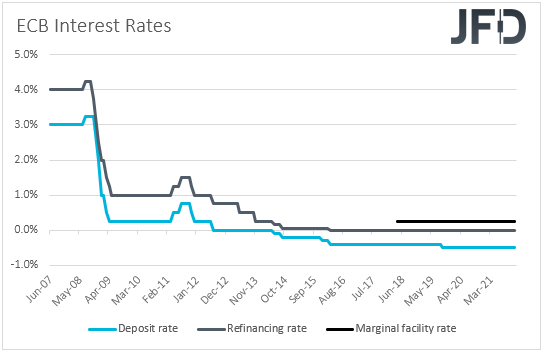
The reaction in the euro was to the upside, perhaps as some market participants have been expecting the Bank to extend its PEPP program in the midst of this uncertainty, or perhaps to increase the pace of APP purchase by more than they did, and thus the actual decision came as a disappointment to them.
However, in our view, the outcome still suggests that at least for now, the ECB remains accommodative. Although officials are expected to slow down the APP in Q3 and bring it back to the current pace in Q4, they maintained flexibility to adjust all their instruments as appropriate. So, if the economic outlook darkens further due to the new restrictions, we cannot rule out maintaining the double pace of APP purchases for longer, or even resume the PEPP. Thus, even if the euro continues to strengthen for a while more, we see its upside being limited, especially against the pound and the dollar, the central banks of which are expected to keep tightening their respective policies much faster than the ECB.
Finally, today, during the Asian session, we got the BoJ decision. This Bank kept its main policy tools unchanged. Namely, it maintained the short-term interest rate target at -0.1%, and the 10-year JGB yield target around 0%. However, it tapered its corporate bond and commercial paper buying, which is a scaling-back move of its pandemic relief measures. This, combined with the fact that other major central banks appear more concerned over inflation than another potential economic slowdown, allowed the yen to march higher as well.
GBP/USD – Technical Outlook
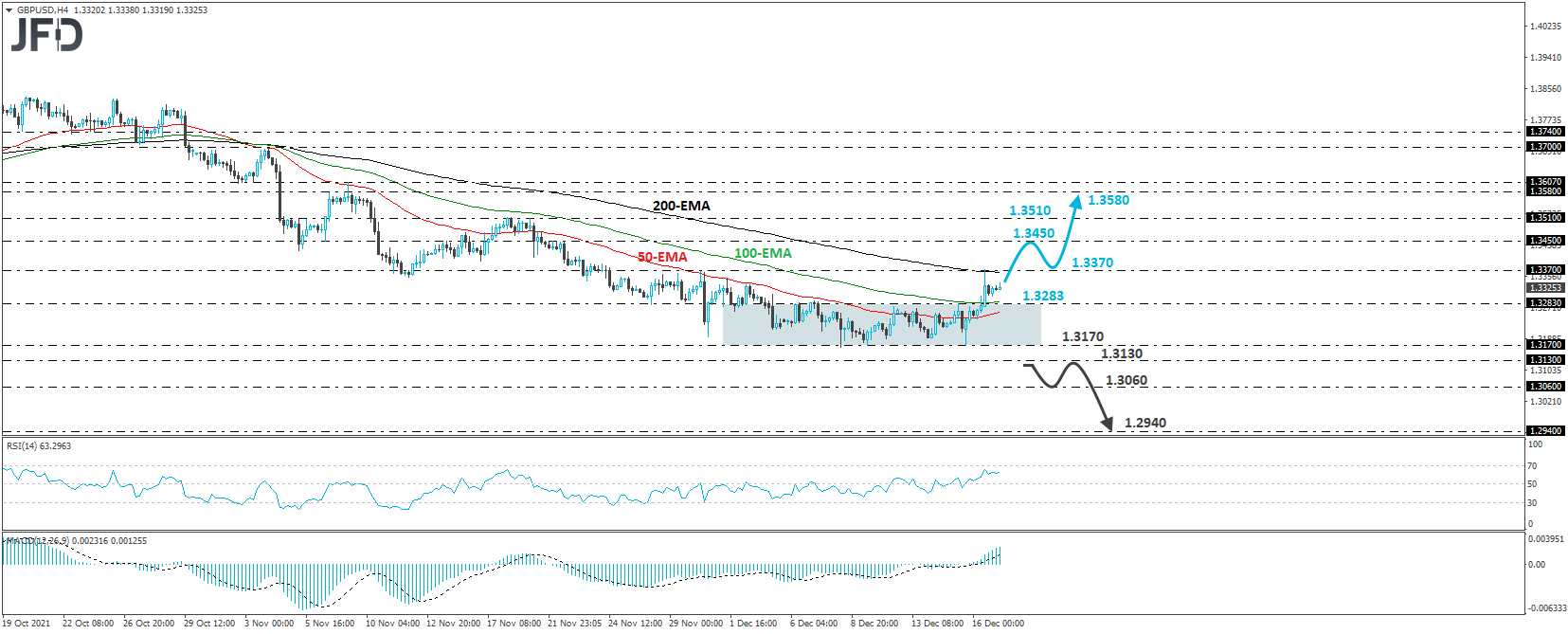
GBP/USD rallied today, after the BoE surprisingly hiked interest rates for the first time since the outbreak of the coronavirus pandemic. The rate broke the upper bound of the sideways range it’s been trading within since December 3rd, to hit resistance near the high of November 30th, at around 1.3370. With that in mind, we believe that the short-term outlook as turned positive for now.
A break above 1.3370 could pave the way towards the high of November 22nd, at 1.3450, where another break could target the 1.3510 area, which prevented the rate from moving further north between November 18th and 19th. If that zone is not able to withstand the pressure either, then its break may pave the way towards the 1.3580/1.3607 area, marked by the highs of November 8th and 9th respectively.
EUR/JPY – Technical Outlook
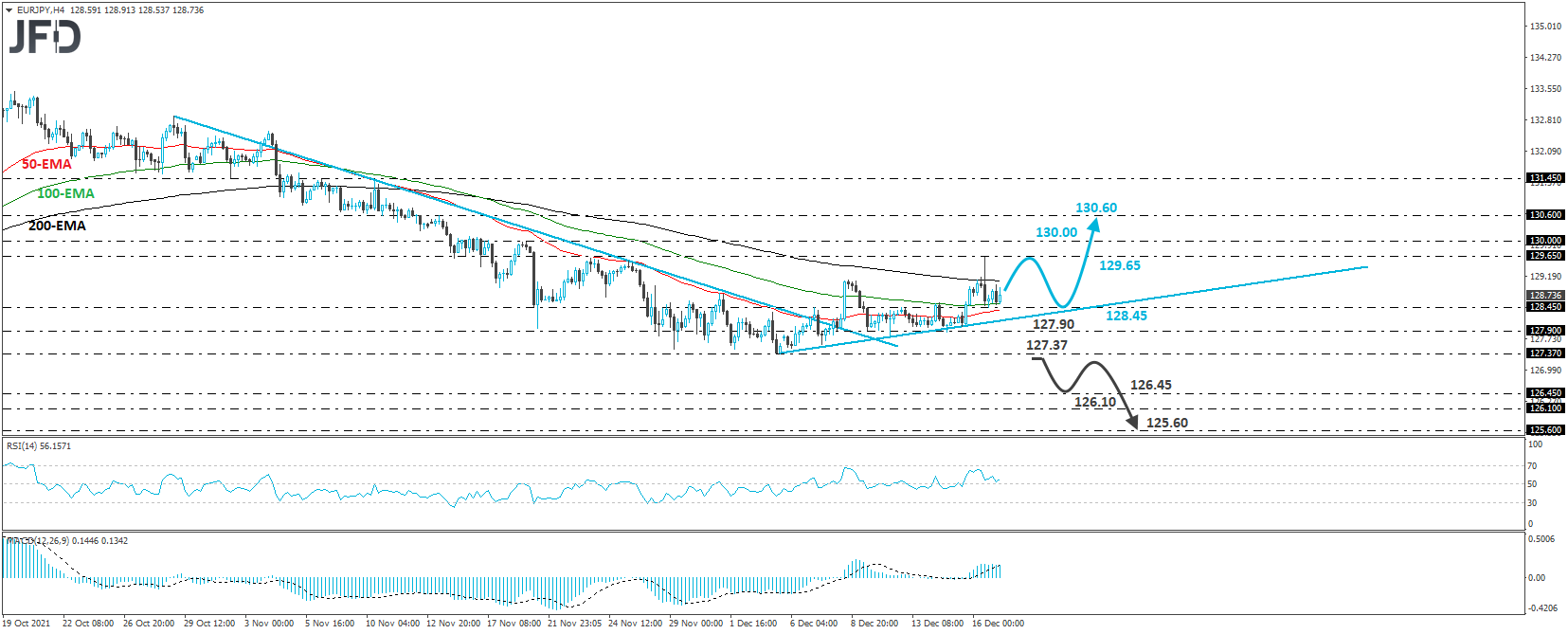
EUR/JPY traded higher after the ECB decision, but hit resistance at 129.65, and then it pulled back to settle near the 128.45 zone. Overall, the pair remains above the prior downside resistance line taken from the high of October 29th, but also above a newly established one, drawn from the low of December 3rd. This suggests that another round of buying could be possible.
If indeed, the bulls decide to take charge again, we would expect them to aim for another test near the 129.65 zone, or even the round number of 130.00, marked by the high of November 19th. Another break, above 130.00, could extend the recovery towards the 130.60 zone, market by the peak of November 15th.
On the downside, we would like to see a clear dip below 127.37 before we start examining the bearish case. This will confirm a forthcoming lower low on the daily chart, and may initially pave the way towards the 126.45 barrier, marked by the low of February 9th. Slightly lower lies the low of February 4th, at 126.10, the break of which could allow declines towards the low of January 27th, at 125.60.
Disclaimer:
The content we produce does not constitute investment advice or investment recommendation (should not be considered as such) and does not in any way constitute an invitation to acquire any financial instrument or product. The Group of Companies of JFD, its affiliates, agents, directors, officers or employees are not liable for any damages that may be caused by individual comments or statements by JFD analysts and assumes no liability with respect to the completeness and correctness of the content presented. The investor is solely responsible for the risk of his investment decisions. Accordingly, you should seek, if you consider appropriate, relevant independent professional advice on the investment considered. The analyses and comments presented do not include any consideration of your personal investment objectives, financial circumstances or needs. The content has not been prepared in accordance with the legal requirements for financial analyses and must therefore be viewed by the reader as marketing information. JFD prohibits the duplication or publication without explicit approval.
CFDs are complex instruments and come with a high risk of losing money rapidly due to leverage. 68.02% of retail investor accounts lose money when trading CFDs with the Company. You should consider whether you understand how CFDs work and whether you can afford to take the high risk of losing your money. Please read the full Risk Disclosure.
Copyright 2021 JFD Group Ltd.