


Wall Street and Asian equities traded in the green yesterday and early today, perhaps due to hopes that there may be some progress in talks between Russia and Ukraine. Indeed, overnight, Ukrainian President confirmed that this was the case. As for today, the main event on the agenda may be the Fed decision. While a 25bps hike is fully priced in, investors may be eager to find out how many more do officials anticipate by the end of the year.
Peace Talks Between Russia and Ukraine Lift Sentiment
The USD dollar traded lower or unchanged against all but one of the other major currencies on Tuesday and during the Asian session Wednesday. It gained slightly only against EUR. The greenback lost the most ground versus CAD, NZD, and AUD, in that order, while it was found virtually unchanged against JPY and CHF.
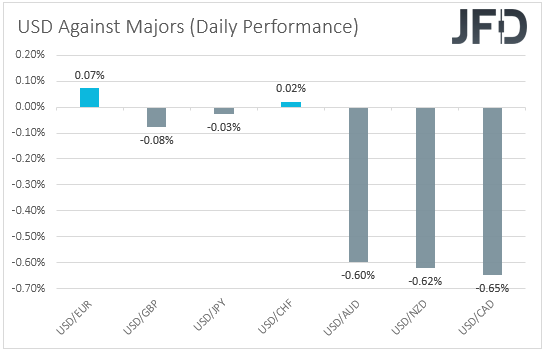
With the dollar found nearly unchanged against the safe havens, yen and franc, we cannot say whether the strengthening of the commodity-linked Aussie, Kiwi, and Loonie, was due to improving risk sentiment, or due to further escalation in the Russia-Ukraine crisis pushing commodity prices higher. For clarifying that, we prefer to turn our gaze to the equity world.
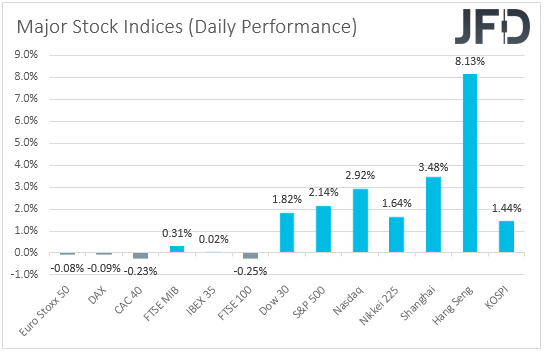
There we see that major European indices traded mixed, within a ±0.35% range, as investors may have stayed nervous due to the surging coronavirus cases in China, but also due to a looming FOMC decision later today. However, Wall Street traded and closed in the green, with the improving optimism rolling into the Asian session today. This may have been due to hopes that some progress could eventually be made in negotiations between Russia and Ukraine, as yesterday’s talks lasted more than the previous rounds, which fell apart very quickly. Indeed, during the Asian session today, Ukrainian President Volodymyr Zelenskiy said that peace talks sounded more realistic this time, though more time is needed.
This is the first time we have progress in negotiations between the two nations. However, we will not get overly excited, and despite equity indices and other risk-linked assets having the potential to trade higher for a while more, we prefer to take the sidelines for now. We prefer to wait for an actual accord before we get confident on a stronger recovery in market sentiment. With strikes and attacks still taking place in Ukraine, even in the midst of negotiations, we cannot rule out another fallout in peace dialogs and further escalation in the conflict.
How Many Hikes Will the New “Dot Plot” Point to?
As for today, investors may turn their gaze to the FOMC decision. With Fed Chair Jerome Powell saying, when testifying before Congress, that he will support a 25bps hike at this gathering, such a move is fully priced in. Thus, in our view, a quarter-point hike by itself is unlikely to prove a major market mover. We believe that investors will quickly turn their attention to the accompanying statement, the updated economic projections, and especially the new “dot plot”.
Remember that when testifying, Powell also said that he is ready to use larger or more frequent rate hikes if inflation doesn’t slow, with last week’s CPI data revealing further acceleration in both headline and underlying inflation. With market participants now pricing in almost 7 quarter-point hikes by the end of the year, it will be interesting to see how many hikes will the dot plot point to.
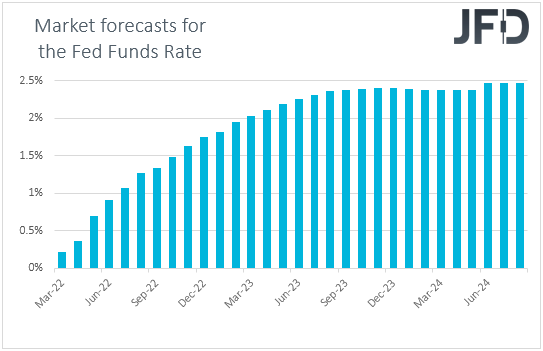
Anything less than what the market currently suggests could disappoint and perhaps result in a setback in the dollar, while equities are likely to extend their gains. For the US dollar to continue marching higher, we would like to see officials matching or exceeding market expectations, something we see as a difficult case if we take into account that the December dot plot pointed only to three rate increases in 2022.
As for the Rest of Today’s Events
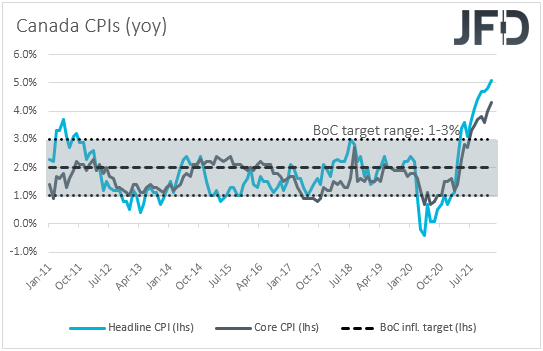
Ahead of the FOMC decision, we have Canada’s CPIs for February, with the headline rate expected to have risen further, to +5.5% yoy from +5.1%. No forecast is available for the core rate. At their latest gathering, BoC policymakers hiked by 25bps, as it was widely anticipated, and, while they acknowledged the uncertainty surrounding Russia’s invasion in Ukraine, they added that rising commodity prices would fuel further inflation and that growth for the first quarter of 2022 now looks more solid than previously projected. This may have encouraged Loonie traders to add to their bets with regards to future rate hikes by this Bank, and accelerating inflation is likely to allow them to add some more, and thereby buy more Loonies.
Tonight, during the Asian session Thursday, Australia releases its employment report for February. The unemployment rate is expected to have ticked down to 4.1% from 4.2%, while the net change in employment is forecast to show that the economy has added 37k jobs after adding 12.9k in January. In our view, these numbers point to a decent report, which may allow market participants to keep their RBA hike bets elevated, and thereby support the Aussie further.
USD/CAD – Technical Outlook
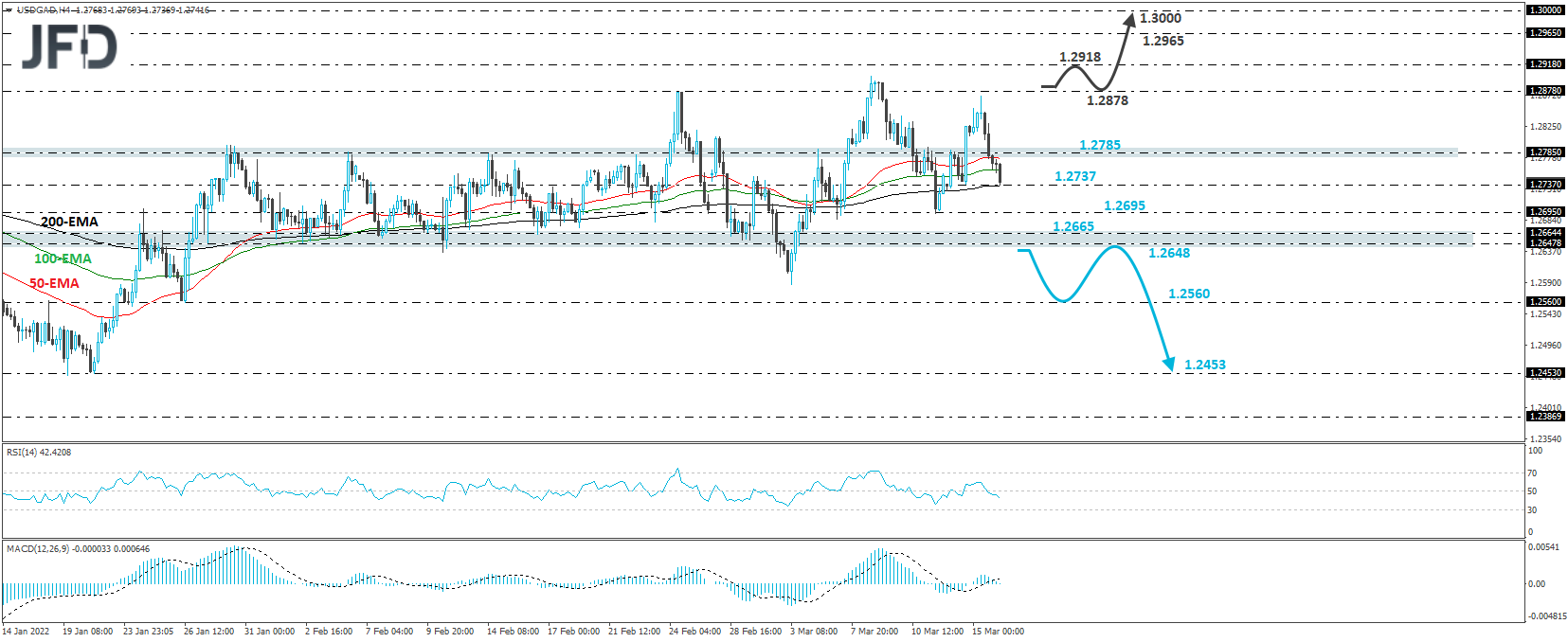
USD/CAD traded lower yesterday, breaking back below the key 1.2785 barrier, which acted as the upper bound of the sideways range that contained the price action between January 26th and February 24th. The lower bound is near the 1.2648 zone. We will still class the territory between those boundaries as neutral and thus, with the rate trading back within that range, we will adopt a flat stance for now.
In order to get confident that larger declines could take place, we would like to see a strong dip below 1.2648. This could encourage the bears to dive towards the low of January 26th, at 1.2560, where another break could set the stage for larger negative extensions, perhaps towards the 1.2453 barrier, which acted as a decent floor between January 13th and 19th.
On the upside, we would like to see a clear break above 1.2878 before we get start examining whether the bulls have gained full control. This could initially target the 1.2918 barrier, marked by an intraday swing high formed on December 22nd, the break of which could target the peak of December 20th, at 1.2965. If this level is not able to stop the bulls either, then we may experience extensions towards the psychological round number of 1.3000.
AUD/JPY – Technical Outlook
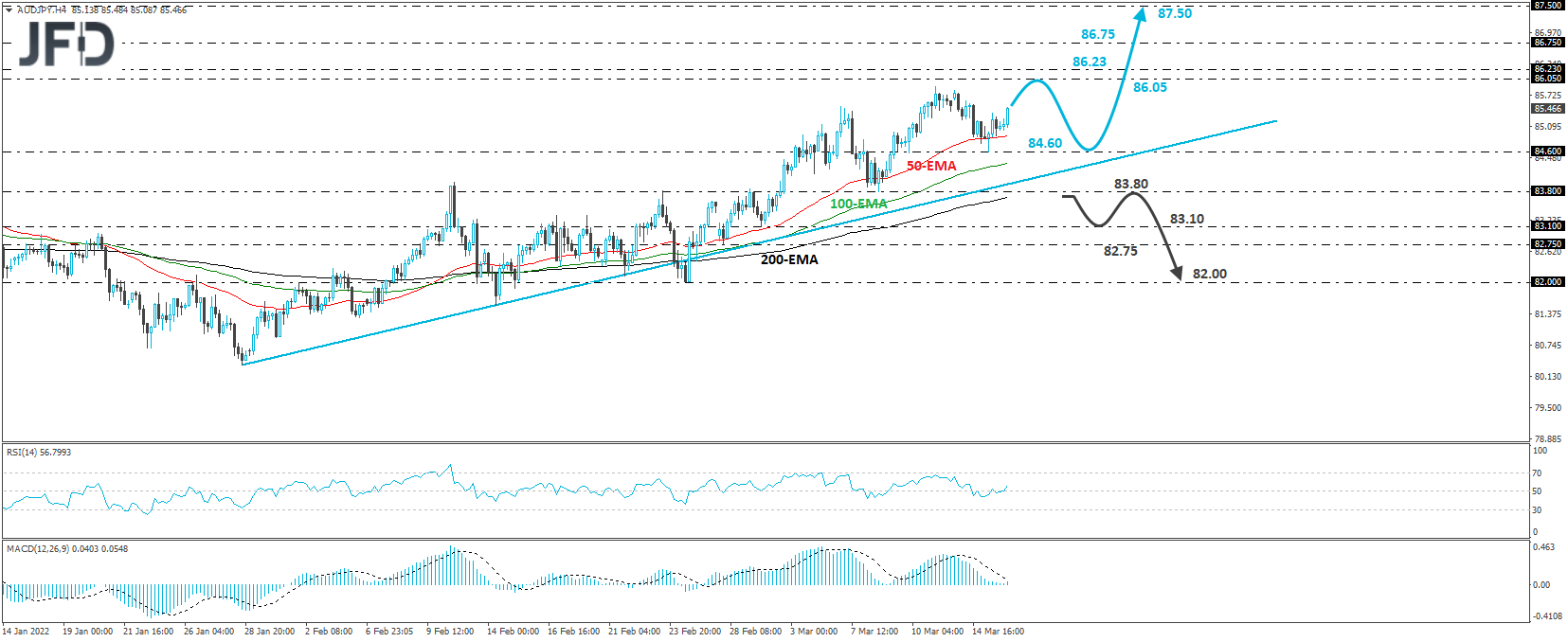
AUD/JPY traded higher yesterday and today during the Asian session, after it hit support at 84.60. Although the pair has yet to test the key territories of 86.05 and 86.23, it remains above the upside support line drawn from the low of January 28th, and thus, we will consider the short-term outlook to still be positive.
If the bulls are strong enough to stay in the driver’s seat, we could soon see them aiming for the aforementioned key levels, marked by the highs of November 1st and October 21st, respectively. If they don’t stop there, then we may experience extensions towards the high of February 6th, 2018, at 86.75, the break of which could target the high of the day before, at around 87.50.
On the downside, we would like to see a clear break below 83.80, the low of March 8th, before we start examining a bearish reversal. This could confirm the break below the pre-mentioned upside line, and may initially target the low of March 1st, at 83.10, or the low of February 28th, at 82.75. If the bears are not willing to stop there, then we may see them diving towards the low of February 24th, at 82.00.
Disclaimer:
The content we produce does not constitute investment advice or investment recommendation (should not be considered as such) and does not in any way constitute an invitation to acquire any financial instrument or product. The Group of Companies of JFD, its affiliates, agents, directors, officers or employees are not liable for any damages that may be caused by individual comments or statements by JFD analysts and assumes no liability with respect to the completeness and correctness of the content presented. The investor is solely responsible for the risk of his investment decisions. Accordingly, you should seek, if you consider appropriate, relevant independent professional advice on the investment considered. The analyses and comments presented do not include any consideration of your personal investment objectives, financial circumstances or needs. The content has not been prepared in accordance with the legal requirements for financial analyses and must therefore be viewed by the reader as marketing information. JFD prohibits the duplication or publication without explicit approval.
CFDs are complex instruments and come with a high risk of losing money rapidly due to leverage. 73.82% of retail investor accounts lose money when trading CFDs with the Company. You should consider whether you understand how CFDs work and whether you can afford to take the high risk of losing your money. Please read the full Risk Disclosure.
Copyright 2022 JFD Group Ltd.