


We don’t have any central bank decisions on this week’s agenda, but we do have events that could attract investors’ attention. On Monday, the last round of Brexit negotiations over a trade deal begins, while on Tuesday, we have the first debate between presidential candidates Donald Trump and Joe Biden. As for the data, the main release may be the US employment data for September, due to be released on Friday.
On Monday, there are no major indicators on the economic agenda.
Focus may fall on the political landscape as, this week, we have the last round of negotiations between the EU and the UK with regards to a trade deal, ahead of next month’s EU summit, at which any potential accord needs to be ratified. Recently, several officials have changed their rhetoric, saying that a breakthrough is possible, with one noting that the deal is 90% there. Thus, if we do see handshakes this week, the pound is likely to gain, while in case of no progress, it could fall back below 1.27 against its US counterpart.
On Tuesday, during the Asian morning, we get the Tokyo CPIs for September and the Summary of Opinions from the latest BoJ meeting. With regards to the CPIs, no forecast is available for the headline rate, while the core one is anticipated to have held steady at -0.3% yoy. As for the Summary of Opinions, we will look for hints on officials’ view over the Japanese economy. In the statement of the meeting, it was noted that the economy “remains in a severe state”, which was an upgrade compared to the previous gathering, in the statement of which it was noted that the economy was in an “extremely severe state”.
During the European session, we get Germany’s preliminary CPIs for September. The CPI rate is forecast to have declined to -0.1% yoy from 0.0%, while the HICP one is expected to have stayed unchanged at -0.1% yoy. This could raise speculation for Eurozone’s headline inflation, due out on Wednesday, to have stayed in negative waters as well.
In the US, the Conference Board consumer confidence index for September is coming out and the forecast points to an increase to 89.2 from 84.8.
On the political front, we have the first debate between Donald Trump and Joe Biden. In general, a Trump reelection may be positive for stocks, as a Trump win would keep the 2017 corporate tax cuts in place, with the President perhaps pushing for more infrastructure spending. Biden may result in a retreat in equities as he has called for an increase in taxes on corporations and high-income individuals. He is also expected to increase regulations on certain sectors and industries, including banks, energy, and healthcare. Having said all that, the first debate may reveal if indeed this is investors’ thinking or not. In other words, we may get a first taste on how the markets may react on the election outcome.
On Wednesday, Asian time, we get Japan’s preliminary industrial production, New Zealand’s ANZ business confidence index, and China’s official PMIs, all for the month of September. Japan’s IP is forecast to have slowed to +1.5% mom from +8.7%, while no forecast is available for New Zealand’s ANZ confidence index. China’s manufacturing PMI is anticipated to have risen fractionally, to 51.2 from 51.0, but there is no estimate for the non-manufacturing index.
During the early EU trading, we get the UK’s final GDP for Q2, which is expected to confirm its initial print, namely that the UK economy has contracted 20.4% qoq in the three months to June. German retail sales for August are also coming out and the forecast points to a 0.4% mom rebound after a 0.9% slide the month before.
From the Eurozone as a whole, the preliminary CPIs for September are due to be released. The headline rate is forecast to have held steady at -0.2% yoy, while no forecast is available for the core one. That said, the HICP excluding food and energy metric is expected to have accelerated to +1.1% yoy from 0.6%.
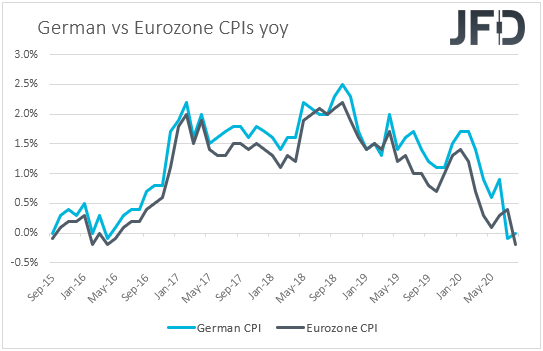
At the prior ECB meeting, policymakers kept monetary policy untouched, reiterating that they stand ready to adjust all their instruments, as appropriate, to ensure that inflation moves towards its aim in a sustained manner. Following the worse-than-expected PMIs for September, with the services sector slipping into contraction, another negative headline CPI print may increase speculation for additional stimulus by the ECB. However, the fact that the core HICP rate is expected to have accelerated means that the weak headline CPI rate may be the result of declines in energy and food, which may allow policymakers to wait for a while more before they decide to push the easing button. They may prefer to wait and see whether the deflationary rate is something temporary or not.
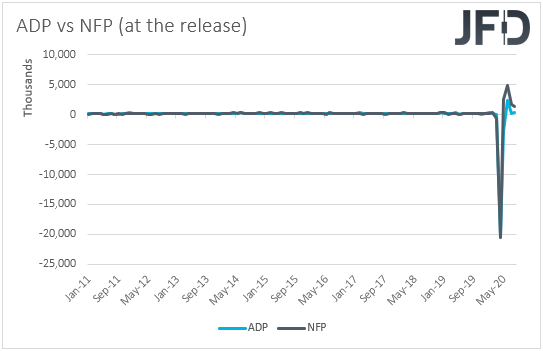
Later, from the US, we get the ADP employment report for September. The forecast suggests that the private sector has gained 605k jobs after adding 428k in August. This may raise speculation that the NFPs, due out on Friday, may come slightly below their own forecast, which is at 875k. That said, we repeat for the umpteenth time that the ADP number is far from a reliable predictor of the NFP print. Even last month, when the ADP revealed a 428k additional jobs, the NFP came in at 1.027mn. The final GDP for Q2 and pending sales for August are also coming out. The final GDP is expected to confirm its second estimate, while pending home sales are forecast to have slowed to +3.2% mom from +5.9%.
From Canada, we get the monthly GDP for July, which is expected to reveal a slowdown to +3.0% mom from 6.5%. However, this would still be a historically strong monthly rate, which combined with the little changed CPIs for the month of August, is very likely to allow BoC policymakers to sit comfortably to the sidelines for a while more. At their latest meeting, they kept policy unchanged, reiterating that they stand ready to adjust their programs if market conditions change.
On Thursday, Chinese markets will be closed due to the Mid-Autumn Festival. In Japan, the Tankan survey for Q3 is due to be released. Both the large manufacturers and non-manufacturers indices are forecast to have risen to -23 and -9 from -34 and -17 respectively.
Later in the day, we get the final manufacturing PMIs for September from the Eurozone, the UK, and the US. As it is the case most of the times, they are expected to confirm their preliminary estimates. From the US, we also get the ISM manufacturing index for the month, which is expected to have inched up to 56.2 from 56.0, as well as the personal income and spending for August. Personal income is forecast to have fallen 2.2% mom after rising 0.4% in July, while spending is anticipated to have slowed to +0.7% mom from +1.9%. The core PCE index for August is also coming out and it is expected to have ticked up to +1.4% yoy from +1.3%.
Finally, on Friday, the main event on the agenda is the official US employment report for September. NFPs are forecast to have increased by 875k, less than August’s 1.371mn, but still a solid number which is consistent with further improvement in the labor market. The unemployment rate is expected to have declined more, to 8.2% from 8.4%, while average hourly earnings are forecast to have accelerated somewhat, to +4.8% yoy from +4.7%.
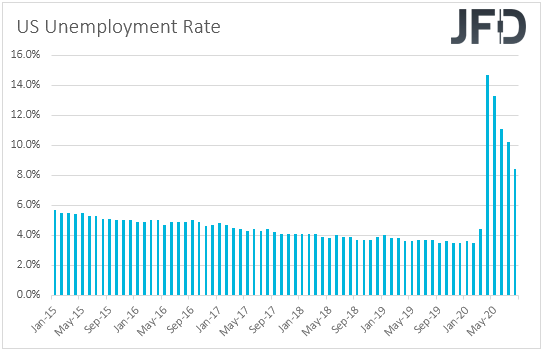
At its most recent meeting, the FOMC kept its policy unchanged, but changed its inflation language noting that they “will aim to achieve inflation moderately above 2% for some time so that inflation averages 2% over time”. With regards, to the new economic projections, officials revised up their GDP and inflation forecasts, and downgraded the unemployment rate ones, while the new dot plot suggested that interest rates are likely to stay at present levels at least through 2023. That said, looking at the details, we see that one member was in favor of a hike in 2022, and four saw rates higher in 2023. Combined with the inflation forecast of 2023, which is at 2%, this shows that some members may not be willing to tolerate inflation above target for long as pointed in the decision statement. Thus, a decent employment report, although it would be a sign that the economic recovery continues, may raise speculation that interest rates in the US may rise somewhat faster than previously anticipated. Something like that may prove positive for the US dollar, but negative for equities. Equity investors may prefer extra-loose monetary policy for longer, as this means cheap loans for companies.
As for the rest of Friday’s events, during the Asian session, Japan’s employment data and Australia’s retail sales for August are coming out. Chinese markets will stay closed in celebration of the National Day. Later in the day, in the US, apart from the official employment data, we also get the factory orders for August and the final UoM consumer sentiment index for September.
Disclaimer:
The content we produce does not constitute investment advice or investment recommendation (should not be considered as such) and does not in any way constitute an invitation to acquire any financial instrument or product. The Group of Companies of JFD, its affiliates, agents, directors, officers or employees are not liable for any damages that may be caused by individual comments or statements by JFD analysts and assumes no liability with respect to the completeness and correctness of the content presented. The investor is solely responsible for the risk of his investment decisions. Accordingly, you should seek, if you consider appropriate, relevant independent professional advice on the investment considered. The analyses and comments presented do not include any consideration of your personal investment objectives, financial circumstances or needs. The content has not been prepared in accordance with the legal requirements for financial analyses and must therefore be viewed by the reader as marketing information. JFD prohibits the duplication or publication without explicit approval.
CFDs are complex instruments and come with a high risk of losing money rapidly due to leverage. 84.25% of retail investor accounts lose money when trading CFDs with the Company. You should consider whether you understand how CFDs work and whether you can afford to take the high risk of losing your money. Please read the full Risk Disclosure.
Copyright 2020 JFD Group Ltd.