


The Kiwi was the main loser among the G10s, coming under strong selling pressure overnight after Westpac said it expects the RBNZ to cut interest rates to -0.5% in November. Now focus for NZD-traders is likely to fall on New Zealand’s jobs data for Q1, due out tonight. We also get Australia’s inflation data for the quarter, but we don’t expect them to alter the RBA’s view on monetary policy. Ahead of those data releases, during the European morning today, the Riksbank will announce its monetary policy Decision.
Equities Trade North on Relaxing Restrictions
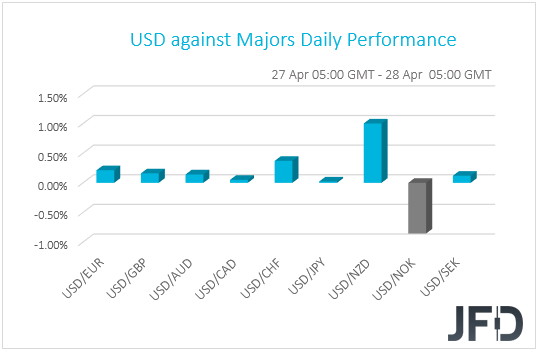
The dollar traded slightly higher against the majority of the other G10 currencies on Monday and during the Asian morning Tuesday. It gained notably only against NZD, while it underperformed versus NOK. The greenback was found virtually unchanged against CAD and JPY.
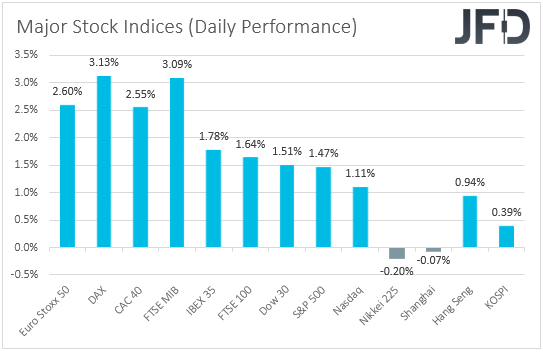
Although not clear by the performance in the FX sphere, market sentiment was supported yesterday, and we can realize that by turning our gaze to the equity world. There, all major EU and US indices closed in positive territory, with the positive morale rolling somewhat into the Asian session today. EU shares were led by airline stocks on hopes that Germany’s and France’s governments will provide aid packages to support the Lufthansa and Air France KLM companies respectively. DAX was the main gainer, perhaps receiving additional support by Deutsche Bank’s better than expected Q1 earnings, while Italy’s FTSE MIB took the second place after the S&P Global agency left Italy’s credit rating unchanged, easing concerns over a potential junk rating. Later in the day, Wall Street may have been boosted by optimism surrounding the coronavirus saga as several US States began relaxing some of the “stay at home” restrictive measures.
As for our view, we will not get too excited and we will stick to our guns that taking things day by day is the best approach. Lifting measures too soon and too quickly just to prevent further economic fallout may prove to be a disaster as it risks another wave of exponential spreading of the virus. In our view, it has to be a very slow procedure, which although will delay any potential rebound in economic activity, the recovery may be much more concrete.
NZD Tumbles on Negative Rate Forecasts, AU CPIs in Focus
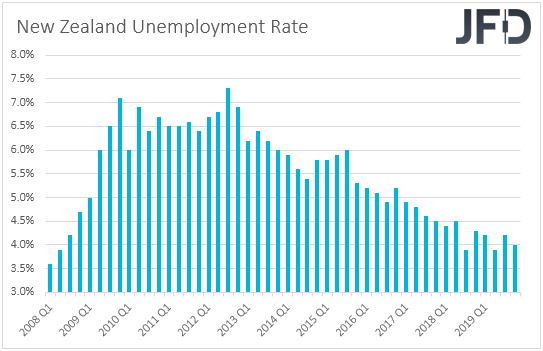
Back to the currencies, the Kiwi came under strong selling pressure overnight after Westpac said it expects the RBNZ to cut interest rates to -0.5% in November, a move that could be telegraphed as early as in August. The bank also expects officials to double their QE program to NZD 60bn in May. For now, NZD-traders may turn their attention to New Zealand’s employment data for Q1, due out during the Asian morning Wednesday. The unemployment rate is forecast to have increased to 4.2% from 4.0%, while the net change in employment is expected to have accelerated to 0.3% qoq from +0.2%. In our view, acceleration in new jobs combined with a rise in the unemployment rate may be a good thing as it could mean more unemployed people getting encouraged to register and start actively looking for a job. Thus, on top of the accelerating inflation for the quarter, a decent employment report may result in second thoughts over the RBNZ’s future course of action.
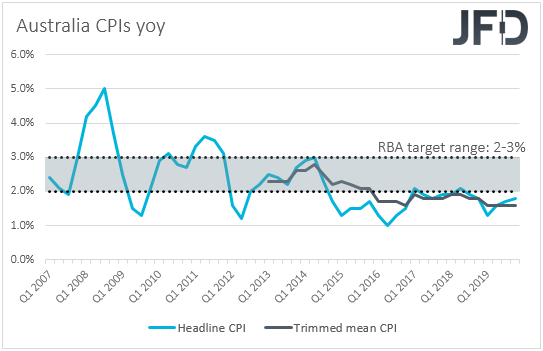
Apart from New Zealand’s jobs data, tonight, we also get Australia’s CPIs for Q1. The headline rate is expected to have risen from +1.8% yoy to +2.0%, which is the lower bound of the RBA’s target range. That said, the trimmed mean and weighted mean rates are expected to have remained decently lower. The trimmed mean one is forecast to have held steady at +1.6% yoy, while the weighted one is forecast to have increased to +1.5% yoy from 1.3%.
When they last met, Australian policymakers left monetary policy unchanged and offered some details with regards to their QE program. They noted that they will do what is necessary to achieve a 3-year yield target of 0.25%, with the target expected to remain in place until progress is being made towards the goals for full employment and inflation. However, they added that if conditions continue to improve, it is likely that smaller and less frequent purchases of government bonds will be required.
After saying that interest rates have reached their effective lower bound at the previous meeting, the aforementioned points suggest that there is very little chance of expanding their QE program. On the contrary, they could soon scale it back if the spreading of the coronavirus continues to level off. Thus, slightly better inflation numbers are unlikely to make them change their minds. We believe that in order for that to happen, the spreading of the pandemic may have to get out of control again.
Riksbank Decides on Interest Rates
Now passing the ball to central banks, following the BoJ’s decision to expand its stimulus efforts in order to combat the economic fallout from the coronavirus pandemic, today, the central bank torch will be passed to the Riksbank. On the 16th and 19th of March, the world’s oldest central bank decided to extend its bond purchases this year by up to SEK 300bn in order to mitigate the effects of the pandemic, while on March 26th, officials decided to initiate purchases of commercial paper issued by Swedish non-financial corporations. It appears that Swedish policymakers do not want to cut rates back into negative waters, and that’s why they are expanding their purchases.
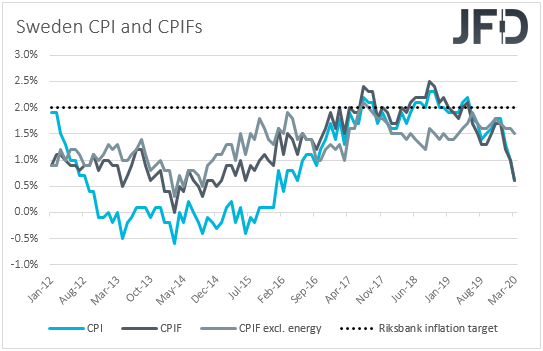
Since then, inflation data showed that both the headline CPI and CPIF rates declined to +0.6% yoy from +1.0%, while the core CPIF one, which excludes energy, ticked down to +1.5% yoy from +1.6%. Given that the slide in the core CPIF rate was not so big as in the headline prints, we can confidently say that the headline declines were mostly due to the tumble in oil prices. This may allow officials to wait for a while more before deciding whether additional measures are needed, as they may prefer to wait and see whether the already adopted measures are having the desired effects.
AUD/CHF – Technical Outlook
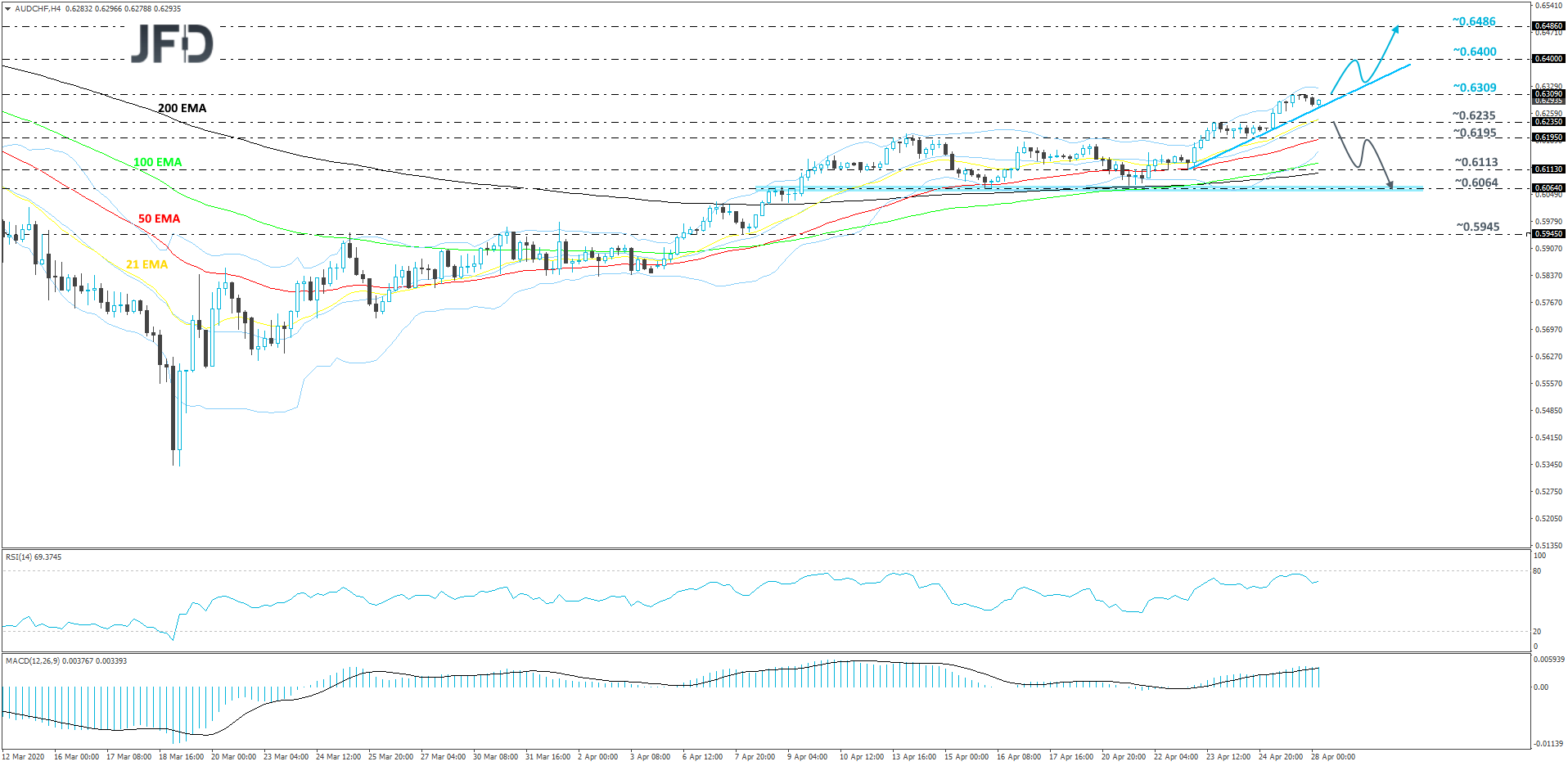
AUD/CHF continues to slowly grind higher, while balancing above a short-term tentative upside support line taken from the low April 23rd. From the near-term perspective, there is a chance for the pair to continue drifting north, especially if that upside line remains intact. We will get even more comfortable with higher areas if the rate climbs above yesterday’s high.
A push above yesterday’s peak, at 0.6309, would confirm a forthcoming higher high, potentially clearing the way to some higher levels. That’s when AUD/CHF may test the 0.6400 zone, marked by the high of February 27th. AUD/CHF might stall there for a bit, or even retrace slightly lower. That said, if the pair remains above the aforementioned upside line, the bulls could take advantage of the lower rate and step in again. Another uprise may overcome the 0.6400 obstacle this time, allowing the pair to aim for the next possible resistance barrier, at 0.6486, marked by the highs of February 24th and 25th.
Alternatively, if the previously-discussed upside line breaks and the rate slides below the 0.6235 hurdle, which is the high of April 23rd, this would also place AUD/CHF below the 21 EMA on our 4-hour chart. The pair could then drift to the 0.6195 obstacle, a break of which may open the door for a further move down, towards the 0.6113 zone, which is the low of April 23rd. If the selling doesn’t stop there, the next support area to consider might be near the 0.6064 level, marked near the lows of April 16th and 21st.
USD/SEK – Technical Outlook
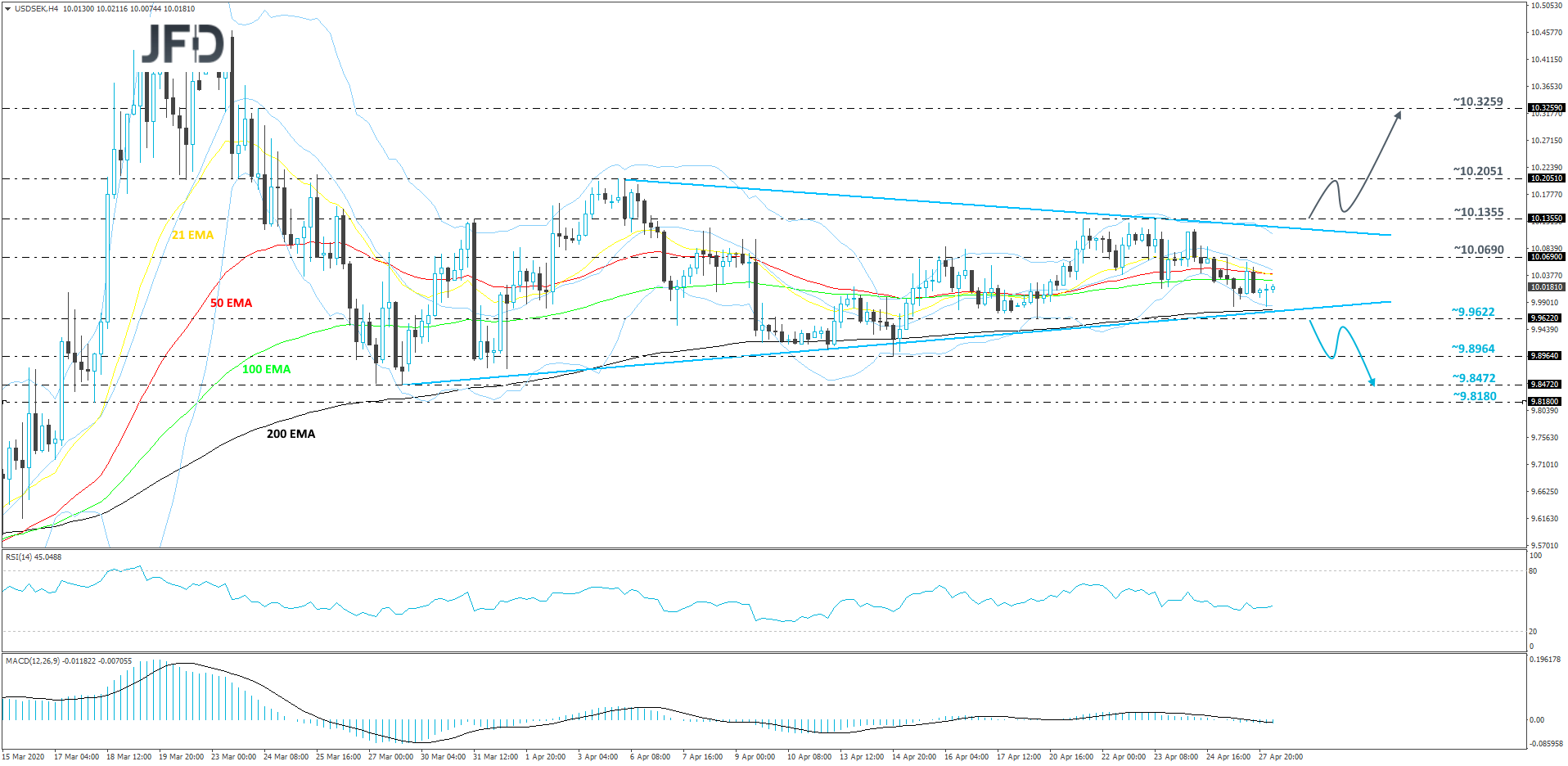
USD/SEK seems to be stuck between two short-term tentative lines: a downside one taken from the high of April 6th and an upside one drawn from the low of March 27th. For now, we will stay neutral and wait for a clear break of one of those lines, before examining the next directional move.
A break of the aforementioned upside line and a rate-drop below the low of April 20th, at 9.9622, could attract more sellers into the area, as this move would also confirm a forthcoming lower low. That’s when the pair could move further down, potentially targeting the 9.8964 obstacle, a break of which could set the stage for a test of the 9.8472 zone, marked near the low of March 27th.
On the other hand, in order to get comfortable with higher areas, we will wait for a break of the previously-discussed downside line and also a push above the 10.1355 barrier, marked near the highs of April 21st and 23rd. Such a move will confirm a forthcoming higher high and more bulls may run into the field. USD/SEK could then travel to the 10.2051 area, which if fails to provide decent resistance and breaks, may open the door for the next move higher, possibly aiming for the 10.3259 level. That level is the high of March 24th.
As for the Rest of Today’s Events
The only releases worth mentioning besides the Riksbank decision is the US Conference Board consumer sentiment index for April, which is forecast to have declined to 87.9 from 120.0, and the API (American Petroleum Institute) weekly report on crude oil inventories, for which no forecast is available.
As for tonight, during the Asian morning Wednesday, apart from New Zealand’s employment report and Australia’s CPIs, we also get New Zealand’s trade balance for March.
Disclaimer:
The content we produce does not constitute investment advice or investment recommendation (should not be considered as such) and does not in any way constitute an invitation to acquire any financial instrument or product. The Group of Companies of JFD, its affiliates, agents, directors, officers or employees are not liable for any damages that may be caused by individual comments or statements by JFD analysts and assumes no liability with respect to the completeness and correctness of the content presented. The investor is solely responsible for the risk of his investment decisions. Accordingly, you should seek, if you consider appropriate, relevant independent professional advice on the investment considered. The analyses and comments presented do not include any consideration of your personal investment objectives, financial circumstances or needs. The content has not been prepared in accordance with the legal requirements for financial analyses and must therefore be viewed by the reader as marketing information. JFD prohibits the duplication or publication without explicit approval.
CFDs are complex instruments and come with a high risk of losing money rapidly due to leverage. 76% of retail investor accounts lose money when trading CFDs with the Company. You should consider whether you understand how CFDs work and whether you can afford to take the high risk of losing your money. Please read the full Risk Disclosure.
Copyright 2020 JFD Group Ltd.