


It’s the last week of the year, with the calendar including very few worth mentioning economic data, and several nations under our radar being on Holiday Monday, Tuesday, and Friday, as Christmas, Boxing Day and New Year’s Day fell and fall during weekends. Therefore, with news surrounding the Omicron variant and Biden’s spending bill being the main drivers last week, we believe that, in the absence of fresh surprising headlines, this could be the case this week as well, especially amid thin liquidity.
Getting the ball rolling with the Omicron coronavirus variant, last week started on fears as the fast spreading of the new strain resulted in several nation going back under full lockdown, and others considering stricter restrictions that could hamper economic growth. However, new reports confirming that Omicron, although more transmissive than its predecessors, leads to fewer hospitalizations and deaths, encouraged market participants to buy the dip in equities during the better half of the week.
Another reason for that may have been headlines that US President Biden’s spending agenda is not completely off the table. Remember that market participants got worried after Senator Manch said he will not support the bill, but their anxiety eased as soon as they understood that fiscal negotiations will continue into next year, keeping the chance for a potential compromise alive.
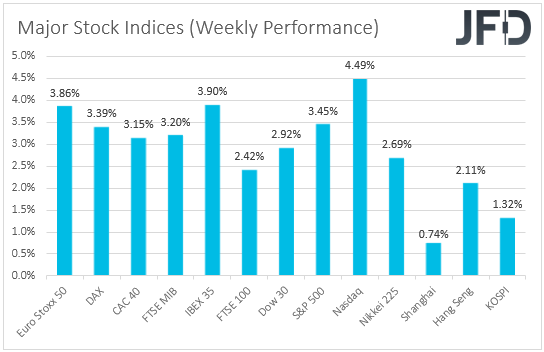
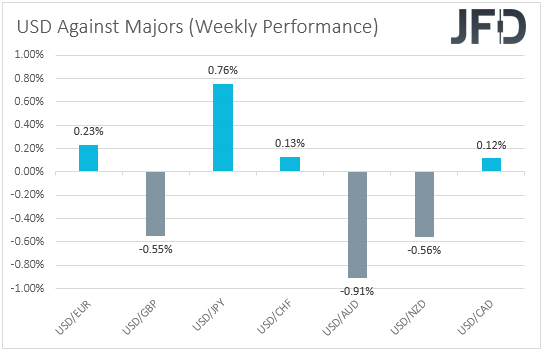
These developments allowed equity indices to add on average around 3.00% each last week, with Nasdaq being the main gainer with 4.49%. The improvement in investors’ appetite was reflected in the FX world as well. The safe-haven yen was the main loser among the majors last week, while the risk-linked Aussie, Kiwi, and pound, were the currencies that gained the most. In our view, this sets the stage for the so-called “Santa rally” this week, as low volume and no new surprising headlines usually allow asset prices to follow the prevailing path of least resistance. However, with US airlines canceling or delaying thousands of flights over the past three days due to the pandemic, several cruise ships canceling stops after outbreaks on-board, and China reporting its highest daily rise in COVID cases in 21 months, we prefer to take things step by step and not just close our eyes and wait for stock indices to add another 3% by the end of the week.
Even if we do experience the “Santa rally” this week, we will not call for a long-lasting recovery. It is too early to suggest that 2022 will be a better year. Yes, most nations may prefer not to tighten further their restrictions this week in order not to spoil the holidays, but this could be the case early next year. With that in mind, and also taking into account that central banks do not have the luxury to add more stimulus into the market, due to overheating inflation, we cannot rule out more setbacks after the turn of the year. We believe that with some central banks raising interest rates faster than others, and a few others refraining from doing so anytime soon, we could experience volatile swings in the FX market as well. We believe that alongside headlines surrounding the coronavirus, monetary policy divergence could also be a main theme for 2022.
Now, as for this week’s data, during the Asian morning Monday we already got the BoJ’s summary of opinions which just revealed that in January, policymakers will have to examine whether the current assessment that the risks to prices are skewed to the downside will remain appropriate. Japan’s retail sales are also out, accelerating by more than anticipated. However, with inflation in Japan near zero, well below the rates of other major economies, we don’t believe that the BoJ will start thinking about tightening monetary policy anytime soon. Therefore, we stick to our guns that the yen is likely to stay mainly driven by developments surrounding the broader market sentiment.
On Tuesday, Japan’s employment report and industrial production, both for November, are coming out, while later in the day, we have the US Consumer Confidence index for December. On Wednesday, we have the US pending home sales for November, and as every week, the EIA crude oil inventory data for the preceding week. Thursday is, as always, US initial jobless claims day, while on Friday, we have the Chinese PMIs for December. There is available forecast only for the manufacturing index, and points to a small decline into contractionary territory.
Disclaimer:
The content we produce does not constitute investment advice or investment recommendation (should not be considered as such) and does not in any way constitute an invitation to acquire any financial instrument or product. The Group of Companies of JFD, its affiliates, agents, directors, officers or employees are not liable for any damages that may be caused by individual comments or statements by JFD analysts and assumes no liability with respect to the completeness and correctness of the content presented. The investor is solely responsible for the risk of his investment decisions. Accordingly, you should seek, if you consider appropriate, relevant independent professional advice on the investment considered. The analyses and comments presented do not include any consideration of your personal investment objectives, financial circumstances or needs. The content has not been prepared in accordance with the legal requirements for financial analyses and must therefore be viewed by the reader as marketing information. JFD prohibits the duplication or publication without explicit approval.
CFDs are complex instruments and come with a high risk of losing money rapidly due to leverage. 68.02% of retail investor accounts lose money when trading CFDs with the Company. You should consider whether you understand how CFDs work and whether you can afford to take the high risk of losing your money. Please read the full Risk Disclosure.
Copyright 2021 JFD Group Ltd.