


El mercado cambió a operaciones con riesgo ayer y hoy en Asia, ya que las esperanzas de reapertura de las economías globales pueden haber vuelto. Las declaraciones de los funcionarios de la Fed de que es demasiado pronto para comenzar a discutir la normalización de las políticas también pueden haber ayudado. En cuanto a hoy, el evento principal puede ser la decisión del Banco de Inglaterra, donde se espera que los responsables políticos desaceleren el ritmo de sus compras de bonos.
Las acciones se recuperan ante la reapertura de las esperanzas de mejora global, el Banco de Inglaterra toma la antorcha del Banco Central
El dólar estadounidense se encontró ligeramente más alto frente a todas las otras monedas del G10, excepto dos, el miércoles y durante la sesión asiática del jueves. Ganó más frente a NOK, SEK y EUR, mientras que tuvo un rendimiento inferior solo frente al NZD y CAD.
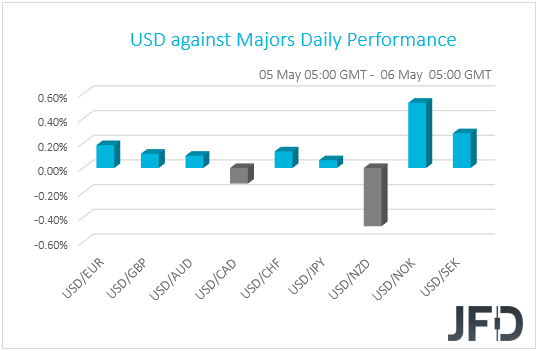
A pesar de la fortaleza relativa del dólar estadounidense, el fortalecimiento del kiwi y el dólar canadiense vinculados a las materias primas, así como el hecho de que el yen japonés se encontró casi sin cambios frente a su contraparte estadounidense, sugieren que los mercados financieros pueden haber operado en riesgo. de moda ayer y hoy en Asia. De hecho, si volvemos nuestra mirada al mundo de la renta variable, vemos que los principales índices de la UE repuntaron con fuerza, marcando su mejor día en casi dos meses. El apetito se suavizó un poco durante la sesión de EE. UU., Con el Nasdaq cayendo un 0,37%, el S&P 500 ganando solo un 0,07%, pero el Down Jones subiendo un 0,29% y alcanzando un nuevo récord. Esto sugiere que los participantes del mercado pueden haber regresado a sectores de orientación cíclica, ya que las esperanzas de reapertura de las economías globales pueden haber regresado. Hoy en Asia, aunque el Shanghai Composite de China ganó solo un 0,14%, el Nikkei 225 de Japón se recuperó un 1,82%.
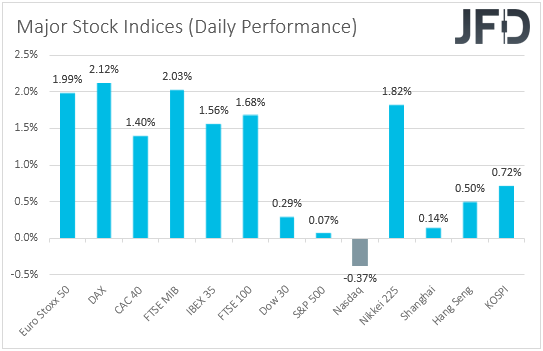
El martes, los índices bursátiles cayeron tras los comentarios de la secretaria del Tesoro de Estados Unidos, Janet Yellen, de que los tipos de interés podrían tener que subir un poco para asegurarse de que la economía no se sobrecaliente. Sin embargo, ayer, varios funcionarios de la Fed sugirieron claramente que no tienen prisa por normalizar la política monetaria. El presidente de la Fed de Chicago, Charles Evans, declaró claramente que espera que la política monetaria se mantenga súper fácil durante algún tiempo, mientras que el presidente de Boston, Eric Rosengren, dijo que las presiones inflacionarias serán de corta duración y no deberían conducir a un retroceso en la política monetaria. Por último, pero no menos importante, Loretta Mester de Cleveland dijo que se necesita más progreso en el mercado laboral antes de que se cumplan las condiciones para reducir el apoyo.
Todo esto está en línea con nuestra opinión de que los participantes del mercado pueden continuar aumentando sus exposiciones al riesgo. Los datos que sugieren que la economía mundial se está recuperando de la pandemia a un ritmo decente, un progreso en los programas de implementación de vacunas, la política monetaria más flexible de la Reserva Federal y la voluntad del presidente estadounidense Biden de proceder con más apoyo fiscal, son una combinación de hechos. lo que sugiere que los índices bursátiles pueden seguir con una tendencia alcista. Las monedas vinculadas al riesgo, como el australiano, el kiwi y el dólar canadiense, también pueden beneficiarse, mientras que el dólar estadounidense y otros refugios seguros, como el yen, pueden estar bajo un renovado interés de venta.
Hablando de monedas, a diferencia del Kiwi y el Loonie, el Aussie no logró superar a su contrapartida estadounidense. Lo hizo durante todo el día de ayer, pero de la noche a la mañana, cayó cuando China dijo que planea suspender indefinidamente todas las actividades bajo el mecanismo de diálogo económico estratégico China-Australia, aumentando las tensiones debido a que Australia actúa sobre los persistentes abusos contra los derechos humanos de China. En cualquier caso, la moneda ahora está recuperando esas pérdidas, lo que sugiere que aún podría verse afectada positivamente por una mayor mejora en el sentimiento general del mercado.
En cuanto a hoy, el evento principal puede ser la decisión de política monetaria del Banco de Inglaterra. En marzo, los legisladores británicos mantuvieron su política sin cambios y señalaron que los planes recientes para aliviar las restricciones relacionadas con el covid pueden ser consistentes con una perspectiva ligeramente más sólida para el crecimiento del consumo. Sin embargo, repitieron que las perspectivas de la economía siguen siendo inusualmente inciertas y que si las perspectivas de inflación se debilitan, están listos para tomar las medidas necesarias.
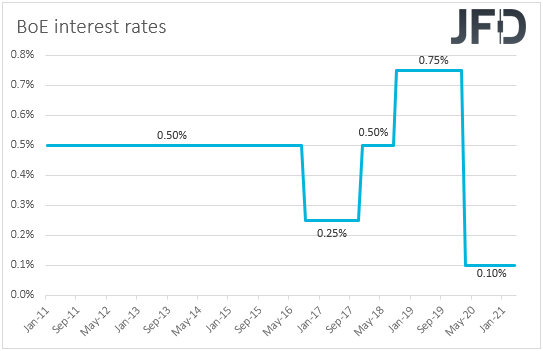
Since then, the UK economy has been recovering from the coronavirus recession faster than expected as the vaccine rollout continues, and market chatter suggests that officials are likely to scale back the pace of their bond purchases at this gathering. The pound could gain on such a decision, but pound traders are also likely to pay attention to the new economic projections, where upside revisions are likely to encourage them to add to their long positions. The big risk today is for policymakers to postpone their decision to slow down their bond purchases, something that could disappoint participants and result in a sliding pound.
AUD/USD – Análisis Técnico
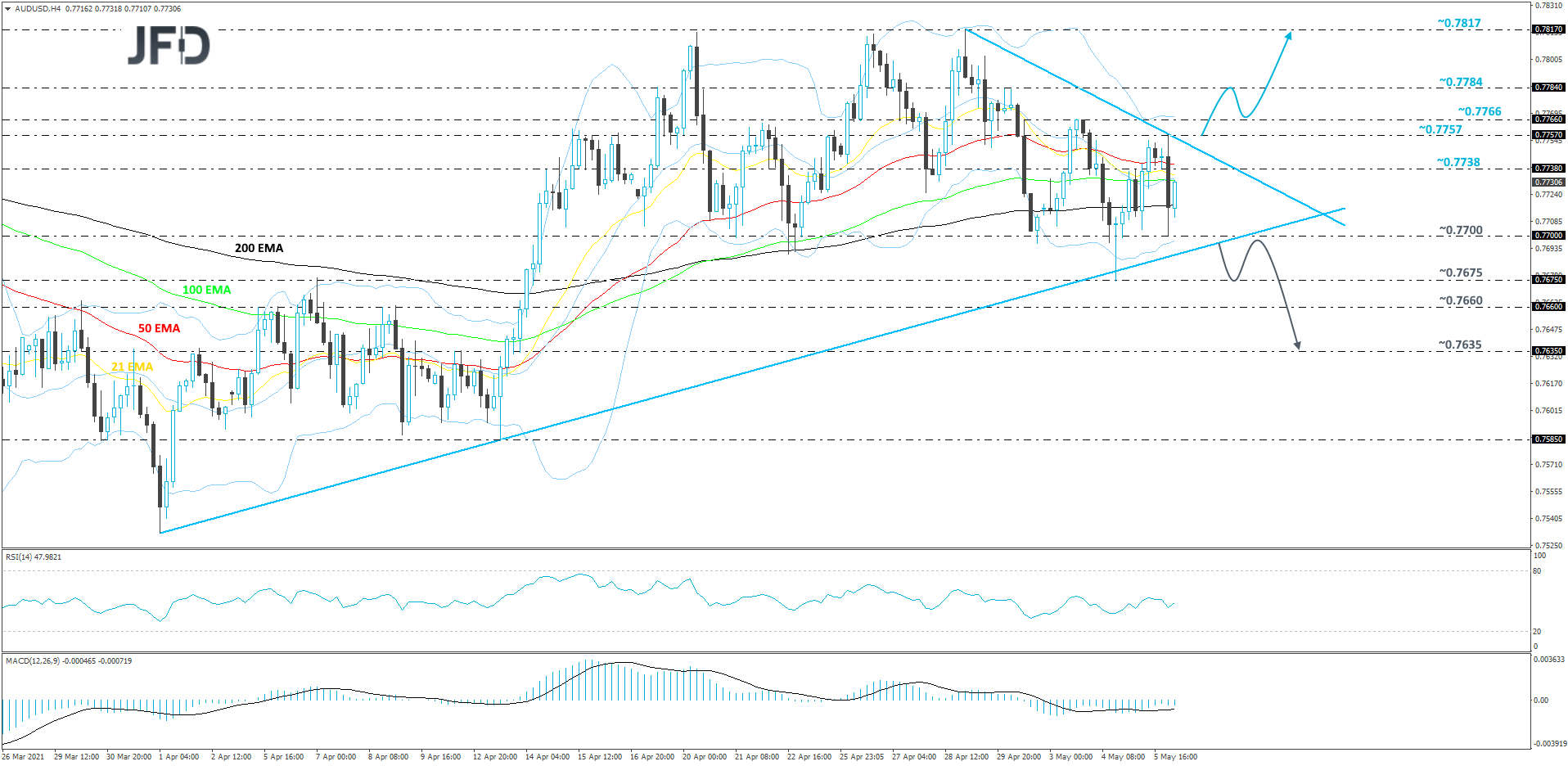
AUD/USD is currently stuck between two of its short-term lines, a tentative downside one drawn from the high of April 29th, and an upside one taken from the low of April 1st. In order to consider the next short-term directional move, a break through one of the lines would be needed. Until then, we will take a neutral approach.
If the aforementioned downside line surrenders and the rate also pushes above 0.7757 barrier, marked by the current high of today, this might invite more buyers into the game. AUD/USD could travel to the 0.7766 obstacle, or even to the 0.7784 zone, marked by the high of April 30th, where a temporary hold-up may occur. If the buying doesn’t stop there, the next possible target might be at 0.7817, marked by the highest point of April.
Alternatively, if the pair ends up breaking the previously mentioned upside line, this could open the way for further declines, as more sellers may see it as a good opportunity to join in. AUD/USD could then travel to the current lowest point of May, at 0.7675, where a temporary hold-up could happen. However, if the bears are still dominating the field, they could overcome the 0.7675 obstacle and aim for the 0.7660 area, or the 0.7635 level, marked by the inside swing high of April 12th.
GBP/JPY –
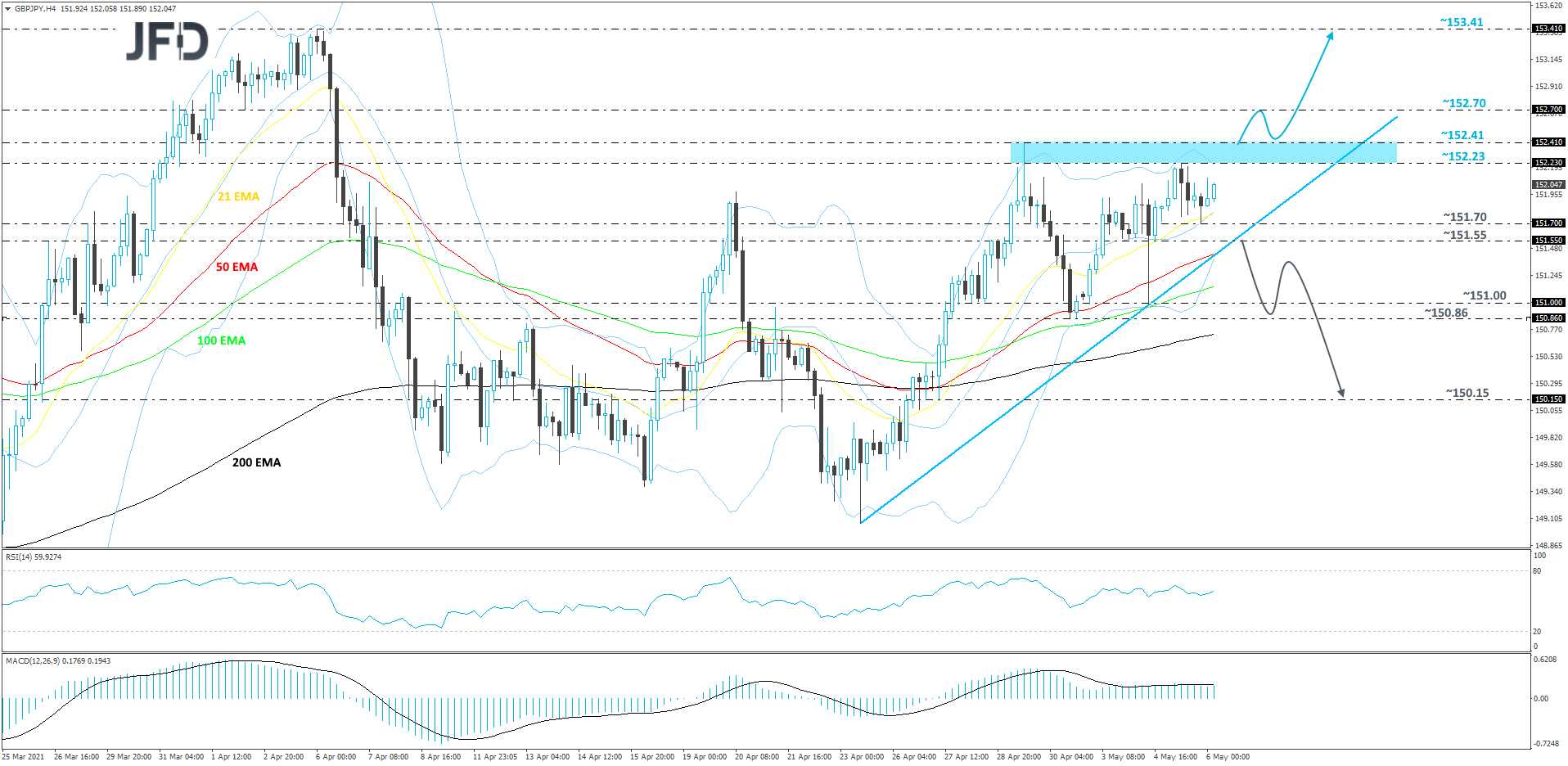
After the reversal to the upside in the end of April, GBP/JPY is currently trading above a short-term tentative upside support line taken from the low of April 23rd. However, before we could get comfortable with further advances, we would need the pair to overcome the resistance area between the 152.23 and 152.41 levels, marked by the highs of May 5th and April 29th respectively. Until then, we will take a cautiously-bullish approach.
If, eventually, the pair does make its way above that resistance area, this would confirm a forthcoming higher high, potentially attracting more buyers into the game. The rate could then get pushed to the 152.70 hurdle, marked by the low of April 2nd and an intraday swing low of April 6th, where GBP/JPY might stall for a bit. It may even correct slightly lower, however, if the rate continues to trade somewhere above the previously mentioned resistance area, which now could take the role of support, then another push north might be possible. If so, GBP/JPY could make its way to the 152.70 obstacle again, a break of which may set the stage for a move towards the 153.41 level, marked by the highest point of April.
Alternatively, if the aforementioned upside line breaks, this could change the direction of the short-term trend, potentially inviting more bears into the field. GBP/JPY might drift to the support area between the 150.86 and 151.00 levels, marked by the lows of April 30th and May 4th. If the slide continues, the next possible target may be at 150.15, marked by the low of April 27th.
Eventos para el resto del día
Besides the BoE monetary policy decision, the other releases worth mentioning are Eurozone’s retail sales for March and the US initial jobless claims for last week. Eurozone’s retail sales are expected to have slowed to +1.5% mom from +3.0%, while the US jobless claims are forecast to have declined slightly, to 540k from 553k.
Tonight, during the Asian session Friday, China’s trade balance for April is due to be released and expectations are for the nation’s trade surplus to have increased to USD 28.10bn from USD 13.80bn.
As for the speakers, we have five on today’s agenda and those are: ECB President Christine Lagarde, ECB Executive Board member Isabel Schnabel, New York Fed President John Williams, Atlanta Fed President Raphael Bostic, and Cleveland Fed President Loretta Mester. During the Asian trading tomorrow, we will get to hear from Dallas Fed President Robert Kaplan.
Disclaimer:
The content we produce does not constitute investment advice or investment recommendation (should not be considered as such) and does not in any way constitute an invitation to acquire any financial instrument or product. The Group of Companies of JFD, its affiliates, agents, directors, officers or employees are not liable for any damages that may be caused by individual comments or statements by JFD analysts and assumes no liability with respect to the completeness and correctness of the content presented. The investor is solely responsible for the risk of his investment decisions. Accordingly, you should seek, if you consider appropriate, relevant independent professional advice on the investment considered. The analyses and comments presented do not include any consideration of your personal investment objectives, financial circumstances or needs. The content has not been prepared in accordance with the legal requirements for financial analyses and must therefore be viewed by the reader as marketing information. JFD prohibits the duplication or publication without explicit approval.
CFDs are complex instruments and come with a high risk of losing money rapidly due to leverage. 79.07% of retail investor accounts lose money when trading CFDs with the Company. You should consider whether you understand how CFDs work and whether you can afford to take the high risk of losing your money. Please read the full Risk Disclosure.
Copyright 2021 JFD Group Ltd.